The Future of Web Solutions Services: Trends to Watch in 2026
Web Solutions Services is going to change the way that companies create and manage their online presence in 2026. The online world is still undergoing significant transformations through technological innovations, and consequently, the utilization of cutting-edge web methods has turned from a voluntary option to an absolute necessity. A company aspiring to be on the winning side must first find and apply the most recent and effective design ideas, second, secure its digital presence with impenetrable security, and third, use modern technology like artificial intelligence and immersive user experience. This year, the big trends are personalized content driven by AI, integrating AR/VR features, using no-code platforms for development, and the popularity of Progressive Web Apps will be major sources of engagement and smooth performance of sites not only for big companies but also for small ones.
This blog is going to talk about The Future of Web Solutions Services: Trends to Watch in 2026. Digital agencies are no longer just partners for website development; they help in creating easy-to-use interfaces, ensuring mobile compatibility, boosting Core Web Vitals, and making it possible to integrate with advanced analytics and automation tools smoothly. In fact, such a business will be even more visible in the digital world when it is able to offer personalized and fast services to customers across all devices if the company is proactive in adopting these web trends. The only way to be on top in 2026 is to apply the latest best practices to your web strategy: innovating, securing and making accessible your digital assets, and putting your resources in flexible solutions that can grow together with your business. The new era of Web Solutions Services is about creating and giving digital experiences that are not just meaningful but that also connect, convert, and captivate.
What Are Web Solutions Services?
Web Solutions Services are a bundle of professional offerings intended for the complete development, improvement, and upkeep of websites or web applications for both businesses and individuals. The services include not only attractive web design and user-friendly interfaces but also technical backend development, search engine optimization (SEO), mobile-friendly features, eCommerce capabilities, and routine site maintenance, among others. The primary goal of Web Solutions Services is to keep a website or application looking good, safe, capable of growing, and fitting the changing requirements of the organization and its customers at the same time.
Typical components of Web Solutions Services include:
- Development of a custom website and web application that meets the unique requirements of the business objectives.
- User experience (UX) and user interface (UI) designing for smooth and easy navigation.
- Installation of content management systems (CMS) for frequent and easy updates of the content.
- Setting up of an online shopping platform with payment handling and product management features.
- Continuous technical support, problem-solving, and maintenance services.
- Responsive design that provides uninterrupted performance on all devices.
- Joining forces with the tools of analytics, automation, and SEO for best online visibility and data-led improvements.
Top Future Trends in Web Solutions Services for 2026
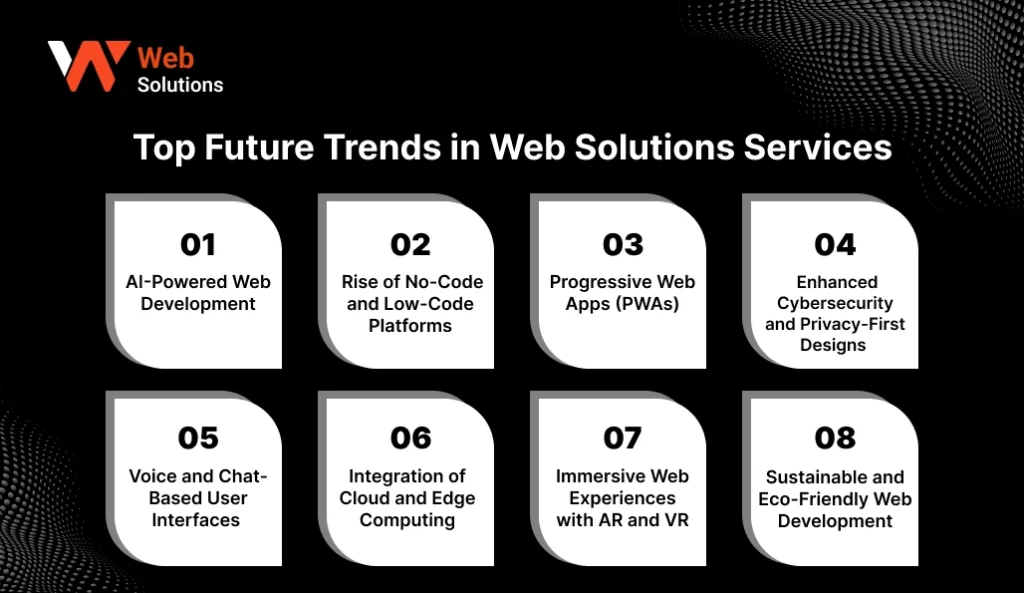
Web Solutions Services in 2026 are going through a big change very fast, mainly thanks to AI, low-code platforms, immersive technologies, and the security and sustainability trends. These technological advancements allow businesses to create their online presence in the most engaging, fastest, and most secure way possible. The only way to keep up with the competition is to embrace these trends and provide not just the usual digital experiences but also the digital experiences that are safe, green, and modern. This will happen because the demand from users and governments will be taken into account.
1. AI-Powered Web Development
Artificial intelligence is taking the lead in the web development field by automating coding, making personalization and website performance better. AI is being used alongside coders for the generation of code, debugging, and also making use of predictive analytics. Frontend-wise, the AI is altering the user experiences depending on the users’ behavior, thus increasing the engagement. The connection of the AI with the edge computing is raising the speed and reliability of the websites, which in turn is making the websites more vibrant and faster in 2026.
Key points:
- Automated coding and debugging
- Personalization via AI-driven content
- Predictive analytics for user behavior
- Integration with edge computing
- Real-time site optimization
2. Rise of No-Code and Low-Code Platforms
No-code and low-code tools grant power to users without any programming knowledge to develop sturdy websites and applications, which in turn shortens the time-to-market and the expense substantially. The above-mentioned platforms provide user-friendly interfaces for easy dragging and dropping of elements as well as design help powered by AI, thus making it possible to have quicker versions. They do not limit the growth of the project and even have connections to the current systems, thus making the online solutions available for both entrepreneurs and large corporations.
Key points:
- User-friendly drag-and-drop tools
- AI-assisted design and development
- Faster product deployment
- Flexibility and scalability
- Integration with enterprise systems
3. Progressive Web Apps (PWAs)
PWAs merge website and app functionalities, offering offline access, fast loading times, and home screen installation without app stores. They provide superior mobile experiences, reduce costs compared to native apps, and improve retention. PWAs are crucial in a mobile-first world, offering businesses improved engagement and broader accessibility.
Key points:
- Offline functionality
- Fast load speeds
- App-like user experience
- Cost-effective alternative to native apps
- Mobile-first design
4. Enhanced Cybersecurity and Privacy-First Designs
Security and privacy are paramount, with web designs embedding strong encryption, secure authentication, and compliance with regulations like GDPR. Privacy-first design minimizes data collection and features cookie consent management. These measures build user trust and protect sensitive information against rising cyber threats.
Key points:
- Strong encryption standards
- Secure authentication methods
- GDPR and global compliance
- Minimal data collection practices
- User consent and transparency
5. Voice and Chat-Based User Interfaces
Voice assistants and AI chatbots enhance accessibility and provide hands-free, natural language interactions. These interfaces improve customer service with 24/7 support and personalized communication. Advanced NLP enables smooth conversational flows, generating higher user satisfaction and engagement.
Key points:
- Natural language processing (NLP)
- 24/7 AI-powered support
- Enhanced accessibility
- Voice-activated navigation
- Personalized conversational experiences
6. Integration of Cloud and Edge Computing
Cloud computing offers scalable resources, while edge computing processes data closer to users, reducing latency. Together, they enable fast, reliable web services capable of handling large-scale traffic and real-time interactions, essential for responsive, global web solutions in 2026.
Key points:
- Scalable cloud infrastructure
- Low-latency edge processing
- Real-time data handling
- Improved global content delivery
- Enhanced site reliability
7. Immersive Web Experiences with AR and VR
The web browser is immediately capable of showing interactive and immersive content through Augmented Reality (AR) and Virtual Reality (VR) technologies. Such advancements create more realistic and appealing scenarios in e-commerce, education, and entertainment by using simulators and user environments which do not demand special applications, thereby expanding the range of immersive digital experiences.
Key points:
- Browser-based AR/VR experiences
- Realistic and interactive content
- Enhanced e-commerce visualization
- Educational simulations
- Entertainment and gaming innovation
8. Sustainable and Eco-Friendly Web Development
Sustainability at the core of web development led to coding that required less energy, hosting that was environmentally friendly, and the use of resources being so well optimized. Eco-friendly web solutions not only cut down on carbon emissions but also matched the rise in demand from customers for responsible digital practices, thus guaranteeing an environmentally friendly online presence.
Key points:
- Energy-efficient coding practices
- Green data centers and hosting
- Optimized media and resource use
- Reduced carbon footprint
- Consumer-driven sustainability focus
Why Choose Modern Web Solutions Services?
The modern web solutions services are a must for the companies that want to get the most out of the digital world that is changing very fast today. By using advanced technologies like cloud computing, mobile-first design, and artificial intelligence, these services create sites that are not only secure and fast but also very interactive and scalable. They take user experience to the next level, increase the visibility of the sites through search engines, and make sure that the sites continue to meet the ever-changing business requirements.
When companies opt for the modern web solutions, they are able to trim the development time, cut down on the maintenance costs, and, at the same time, improve their security and privacy compliance to a great extent. The personalization features driven by artificial intelligence result in higher customer engagement and conversion rates. The websites built on scalable architectures can manage the increased traffic and additional functions effectively without the risk of performance degradation.
Aside from that, the modern solutions are environment-friendly, as they apply eco-friendly development practices and use green hosting, thus taking the businesses into line with the global environmental goals. With support and updates at all times, the businesses can always be one step ahead of the trends and the technological changes.
Key Benefits:
- Advanced technology integration for speed and security
- Superior user experience and SEO optimization
- Mobile-first, responsive design for all devices
- Robust cybersecurity and privacy compliance
- Sustainable and scalable digital solutions
Conclusion
To sum up, the advent of new Web Solutions Services has become an inseparable tool for the companies that are planning to flourish in the very cutthroat digital environment of 2026 and after. These services fuse the best technologies, such as artificial intelligence in programming, cloud and edge computing, and mobile-first design to produce fast, safe, and microorganism-free websites personalized for the changing user situation. Through the use of modern web solutions, the companies not only enhance customer engagement and better the user experience but also guarantee strong cybersecurity and privacy compliance, factors that are extremely important for creating trust in the current data-sensitive world.
Moreover, modern solutions not only enabled companies to increase their operational efficiency by automating their processes and cutting maintenance costs but also provided the additional benefit of real-time data analytics that very much support the making of informed decisions. The platforms are so versatile that businesses are able to expand their activities without any disruption; therefore, the upgrade in traffic and some other new requirements can easily be managed with them. In addition, modern solutions’ eco-friendly and sustainable web development practices help to cope with the increasing demand of responsible digital operations, thus concurrently attaining the goal of business and environmental sustainability.
Eventually, professional web solution providers’ partnerships allow the companies to be in sync with the market changes, support the generation of innovative ideas, and keep up their competitive advantage. Modern Web Solutions Services are indeed no longer just common tools but strategic resources that are supporting business development, operational excellence, and customer satisfaction; thus, they are a prudent and necessary investment in today’s digital economy.
Key Takeaways:
- Technological integration giving support to speed, security, and scalability
- User engagement along with privacy compliance being improved
- Automated processes and data analytics leading to operational efficiency
- Green and sustainable development practices
- Business’s digital presence made future-proof for growth and innovation
FAQs
1. What are the modern web solution services?
Modern web solution services are a set of advanced technologies that not only do and incorporate artificial intelligence (AI) but also come with a mobile-first design and cloud computing, among other traits, in order to create websites that are fast, secure, and scalable. They work on improving not only user experience but also SEO, cybersecurity, and sustainability while at the same time advancing business needs for digital performance and growth that are efficient and optimized.
2. What is the advantage of AI-powered web solutions for my business?
AI indeed takes part in the coding automation, user experience personalization, and website performance optimization in real-time; to be precise, these are the activities of AI. It minimizes the time and cost of development; at the same time, it increases the interaction through customized content and forecasting analytics, which in turn leads to the improvement of the conversion rates and operational efficiency.
3. Why is a mobile-first design indispensable in 2026?
Mobile-first design will be applied in the case of more than 60% of the total global traffic that is coming from mobile devices. Besides, it gives the site improved engagement and retention through making mobile responsiveness a priority in the development process, thus assuring seamless usability, faster load times, and higher ranking on Google search.
4. How does modern web service boost security?
They incorporate encryption, multi-factor authentication, and privacy-compliant practices such as GDPR adherence. User data is continuously protected through security updates and proactive threat monitoring, which helps to build trust and prevent costly breaches.
5. What is meant by a sustainable web solution?
A sustainable web solution is the one that employs energy-efficient techniques, green hosting, and resource optimization to achieve the least possible carbon emission during its life cycle. Digital growth and environmental concern are synced together as they meet the consumer’s demand for eco-friendly business practices.