
How Much Does It Cost to Create an Ecommerce Website?

An ecommerce site is really important for any business that wants to reach people and sell to more customers, no matter how big or small the business is. An ecommerce site lets you sell things all the time from anywhere in the world. You can help your customers better than you could before.
Statista researchers predict that global e-commerce sales will exceed $8 trillion by 2027. The data demonstrates increasing online shopping patterns among consumers. Ecommerce represents an essential component of all sales, which makes it vital for businesses to maintain their success. Ecommerce platforms enable businesses to sell products to international customers, which benefits their operations.
You want to find out the costs required to develop an ecommerce website. The expenses required to construct an ecommerce site will differ among different people according to their specific requirements. The final price depends on several factors, including the design complexity, the selected ecommerce platform, the features of your ecommerce site, and the chosen method of constructing your ecommerce business.
The expenses of developing your e-commerce site through inexpensive methods will be lower than the costs of creating a custom e-commerce site. The blog will guide you through building an ecommerce site while providing information about the expenses involved in this process and which specific amounts to budget for each project phase.
TL;DR
- Simple ecommerce websites usually cost between $250 to $1,200
- Mid-level ecommerce websites are generally priced from $1,200 to $6,000
- Advanced ecommerce websites can cost $6,000 and above, depending on requirements
- The choice of platform, such as Shopify or a fully custom-built website, significantly impacts the final cost
Key Points
- The cost of an ecommerce website primarily hinges on the intricacy of the design features, platform, and level of the development team.
- Basic ecommerce sites that cost between $250 and $1,200 are ideal for startups and include only essential features and a minimalist design.
- Mid-level ecommerce sites cost from $1,200 to $6,000 and provide customers with more customization options, integrations, and better performance.
- Advanced ecommerce sites can easily cost $6,000 and up to $25,000+ depending on your requirements for custom development and scalable capabilities.
- Shopify is a cost-effective way to start your online business while a custom development would be the best fit if you need more flexibility, scalability and are ready to invest more overall.
How Much Does It Cost to Create an Ecommerce Website?
The cost of building an ecommerce website is figured out by what your business wants to do, the features you want, and how complicated the design is. The platform you pick. Every business is different. The cost is different, too. Some people just need an e-commerce website, while others need a big website that can handle a lot of traffic and has special features that are just for them.
To simplify, ecommerce website costs can be broadly categorized into three types: basic, mid-level, and advanced websites.
Generally, the cost of a basic ecommerce website ranges from $250 to $1,200, making it an ideal option for startups and small businesses looking to launch quickly with essential features and minimal investment
1. Basic Ecommerce Website Cost
Best for: Startups, small businesses, or individuals starting their first online store
Essential elements of an ecommerce website require product listings, shopping cart functionality, payment gateway support, and basic website design. The websites use pre-designed templates because this approach helps maintain their budget requirements.
Typically, the cost of a basic ecommerce website ranges from $250 to $1,200, depending on the platform, number of products, and level of customization required.
Cost Breakdown:
| Component | Estimated Cost ($) |
| Domain & Hosting | $35 – $120 |
| Design (Template) | $60 – $250 |
| Development | $120 – $600 |
| Basic Features | $60 – $250 |
| Total Cost | $250 – $1,200 |
Explanation:
- Domain & Hosting: This is the foundation of your website. Hosting plans are usually affordable for low-traffic sites.
- Template Design: Pre-designed themes reduce design time and cost significantly.
- Development: Basic setup, product upload, and payment integration are included.
- Features: Limited to essentials like cart, checkout, and user login.
This option is ideal if you want to launch quickly with a limited budget.
2. Mid-Level Ecommerce Website Cost
Best for: Growing businesses that need better performance and customization
Mid-level ecommerce websites provide their users with three advantages which include better design capacity, additional features that support third-party integrations, and an advanced user interface filtering system.
The cost of a mid-level ecommerce website typically ranges from $1,200 to $6,000, depending on the level of customization, integrations, and overall project complexity.
Cost Breakdown:
| Component | Estimated Cost ($) |
| Domain & Hosting | $60 – $250 |
| Custom Design | $250 – $1,000 |
| Development | $600 – $2,500 |
| Integrations | $250 – $600 |
| Total Cost | $1,200 – $6,000 |
Explanation:
- Custom Design: A unique design improves branding and user experience.
- Development: More complex coding for better performance and features.
- Integrations: Includes payment gateways, CRM tools, shipping APIs, and analytics.
- Hosting: Better hosting ensures faster loading and handles more users.
This level is suitable if you want to scale your business and improve conversions.
3. Advanced Ecommerce Website Cost
Best for: Large businesses, enterprises, or high-traffic online stores
Advanced ecommerce websites provide better design alternatives and additional capabilities through their third-party integration features, advanced filtering systems and improved user experience. The development of these websites employs custom design elements together with enhanced functionalities to meet the evolving requirements of expanding businesses.
Typically, the cost of a mid-level ecommerce website ranges from $1,200 to $6,000, depending on the level of customization, integrations, and overall project complexity.
Cost Breakdown:
| Component | Estimated Cost ($) |
| Premium Hosting | $250 – $1,200 |
| UI/UX Design | $1,200 – $3,500 |
| Development | $3,500 – $12,000+ |
| Advanced Features | $2,500 – $6,000 |
| Total Cost | $6,000 – $25,000+ |
Explanation:
- Premium Hosting: Needed to handle high traffic and ensure fast performance.
- UI/UX Design: Highly optimized interfaces for better engagement and conversions.
- Development: Includes custom backend systems, APIs, and scalable architecture.
- Advanced Features: AI recommendations, multi-language support, automation, and analytics dashboards.
This is the best choice if you want to build a powerful, enterprise-grade ecommerce platform.
How to Create an E-Commerce Website?

You need to establish your business model before you can create your e-commerce website because this model will determine your choice of platform and your setup of domain and hosting services. The design process requires you to create a user-friendly interface while implementing essential features such as payment, shipping systems and conducting tests to verify that all components work properly; provide secure and uninterrupted shopping experiences for customers.
1. Define Your Business & Choose Platform
Begin your process by selecting the products that you will market to customers. The business foundation requires you to gather knowledge about your target audience, competitors, and your unique selling proposition.
Next, you need to select the appropriate platform for your needs, which includes Shopify as an easy solution, WooCommerce as a flexible option, Magento for scalability purposes, and custom development when you require complete system control based on your financial capacity and technical needs.
2. Register Domain and Hosting
You should choose a domain name that matches your business persona and at the same time, is simple for users to remember. The cost of a domain name varies from $10 to $25 per year, depending on its availability status.
It is important to keep in mind the key features of the hosting service provider you are choosing in a reliable manner such as quick website loading and site security. The yearly spending on hosting services varies from $35 to $180, depending on the traffic of the e-commerce website, storage, and other performance factors.
3. Design a User-Friendly Website
The visual design should focus on making things look attractive, which, in turn, will enhance the user experience through clean design elements. Furthermore, design has to present customers with simple navigation routes that will allow them to browse products without any confusion or hindrances.
Making your website easier for people who view it on their smartphones (aka mobile devices) is a very smart decision because it will help you build stronger relationships with your prospective customers, who are likely to become your long-term customers (for life). To get customers to pay attention to product pages, product pages must contain visually appealing images, clear written content, and a price, which is the most important feature on the product pages.
4. Add Features and Integrations
Make sure your e-commerce website has the basic elements like product listings, shopping carts, secure checkouts, user profiles, and order tracking. With these features, your customers will enjoy a shopping experience that is both smooth and efficient.
Besides, integrating payment gateways such as Razorpay, Stripe, or PayPal and configuring the shipping methods are also necessary steps. Giving customers multiple payment and delivery options not only boosts their satisfaction, but also minimizes the chances of them abandoning their carts.
5. Test and Launch Your Website
You need to test your website for performance testing, which includes speed and responsiveness testing, together with complete verification of all website features and functions. before you launch your site. You need to confirm that all links function correctly, while every webpage loads without problems, and the entire checkout process functions smoothly.
Fix bugs, reduce loading time, and test your payment system before launch. This way, when you “go live” with your e-commerce store promotion, you’ll be able to do so confidently!
Key Factors Affecting Ecommerce Website Cost
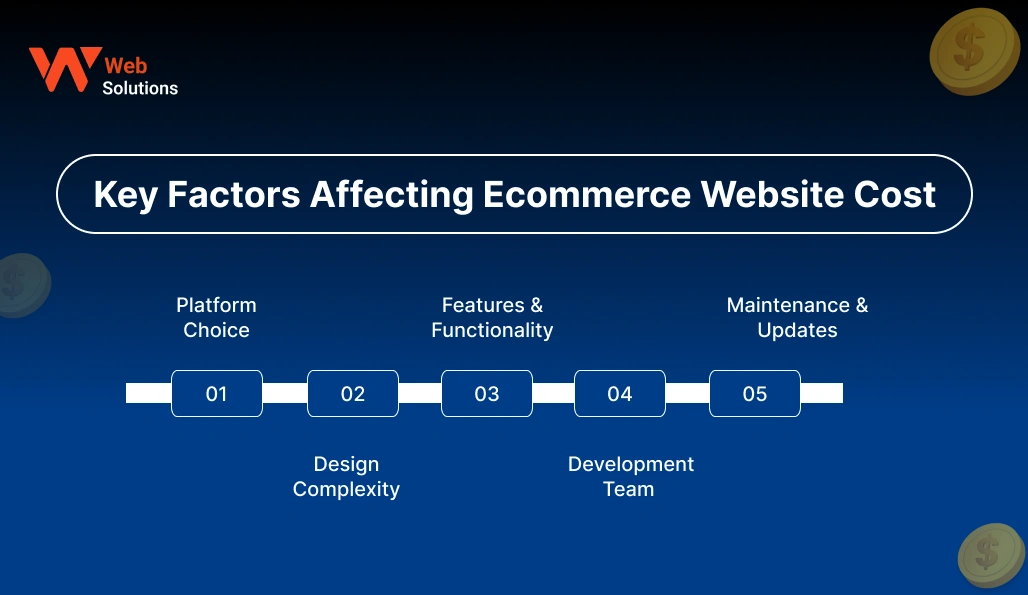
Some of the things that affect your pricing of the ecommerce platform are choosing a platform, design complexity, the number of features, the development team, and maintenance, being the last one but not the least important. These elements will influence your one-off investment and recurring costs. Knowing about these factors will allow the company to properly set the budget and develop an ecommerce website that is scalable and high-performing, as well as align their goals and please the customers.
1. Platform Choice
Which platform you pick can affect your ecommerce site’s cost, performance, and scalability quite a bit. Every platform has different pricing structures, features, and ways to customize, and all these things together decide your final expenditure.
- Shopify: Lower upfront cost, easy to use, subscription-based, includes hosting and security
- WooCommerce: Affordable and flexible, but requires plugins, hosting, and regular maintenance
- Custom Development: Expensive but offers full control, advanced customization, and long-term scalability
If you want a quick and budget-friendly launch, go with platforms. For unique features and long-term growth, custom development is the better investment.
2. Design Complexity
Design changes the product’s appearance only to a certain extent; it influences the user experience, user engagement, and even the conversion rate significantly. To a large extent, your design is unique and interactive your design is, so the higher the development cost will be.
- Simple Templates: Cost-effective, fast to implement, suitable for startups and small businesses
- Custom UI/UX Design: Requires more time and investment but improves branding, usability, and customer trust
A visually appealing and user-friendly design can significantly increase customer retention and sales.
3. Features & Functionality
The features that you select determine the strength and performance capabilities of your ecommerce website system. The addition of advanced features such as automation, AI tools, and integration systems will extend both development time and costs, but these features will enhance user experience and facilitate the future growth of your website.
- Basic Features: Product listings, shopping cart, checkout system, user accounts
- Advanced Features: AI recommendations, multi-vendor systems, real-time analytics, chat support, automation
Focus on essential features first and scale gradually to manage costs effectively while meeting customer expectations.
4. Development Team
The budget and quality of your e-commerce website largely depend on who you hire. The different options available to you provide various levels of expertise and support, together with different pricing systems that determine how well your project will run, its capacity to grow, and its overall success.
- Freelancers: Budget-friendly and suitable for small projects, but may lack scalability and long-term support
- Agencies: More expensive but offer experienced teams, structured workflows, quality assurance, and ongoing support
For complex projects or business growth, investing in a professional agency ensures better reliability and performance.
5. Maintenance & Updates
Operating an ecommerce website efficiently, securing it, and ensuring compatibility with the latest technologies are the aspects that require continuous renovation. You should never ignore this as a regular cost.
- Regular updates for software, plugins, and platform
- Security patches to prevent data breaches and cyber threats
- Performance optimization for speed and better user experience
Estimated yearly maintenance cost: $120 – $1,200+
Regular maintenance helps your website stay secure, fast, and ready to handle increasing traffic and business growth.
Suggested article: Top Magento Development Companies in 2026
Benefits of an Ecommerce Website
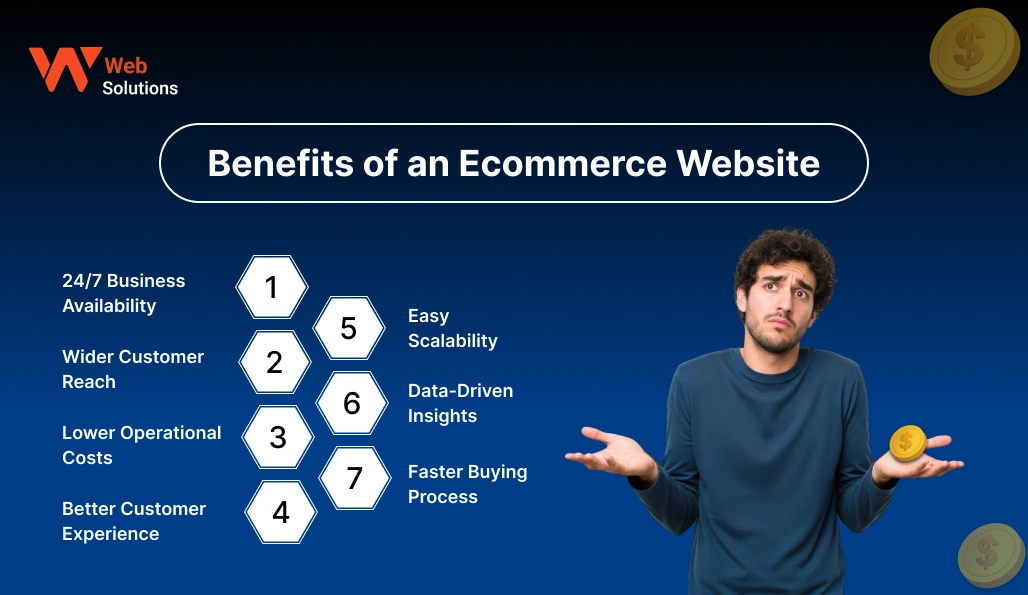
An online store or an ecommerce website is a great way to extend your business in the digital world. Through such a platform, besides being able to access a high number of people, you can also increase customer satisfaction, cut down on your expenses related to running a business, and get access to data that is very helpful. Since more and more people are choosing to shop online, owning an ecommerce site is the key step if you want your business to be successful, grow, and expand in the future.
1. 24/7 Business Availability
The main advantage of an ecommerce site is that it gives your business the capability to run non-stop all day long. Shoppers normally have only certain hours when they can visit a physical store; with an online store, they can browse the product listings and carry out transactions whenever they want, day or night. Being open 24/7 helps a business make more sales and at the same time, gives customers constant access to their services.
2. Wider Customer Reach
Having an ecommerce site will also let you take your business beyond the boundaries of the location where it is geographically situated. Not only will local selling things be your thing, but also national and international ones. What comes as a result is that you will be able to reach a bigger audience, increase your brand awareness, and enter new markets without the necessity of spending money on physical store expansion.
3. Lower Operational Costs
Compared to the conventional brick-and-mortar stores, ecommerce websites have significantly fewer investment needs. You can save on things like rent, utilities, and large staff requirements. So, it becomes a little bit easier for startups and small businesses to enter the market and be profitable while working efficiently.
4. Better Customer Experience
Ecommerce websites provide a smooth and hassle-free way of shopping. Features like a user-friendly website, thorough product descriptions, customer reviews, and personalized suggestions help customers decide effectively. On top of that, a quick and easy checkout process not only delights users but also motivates them to come back for more.
5. Easy Scalability
With the development of your business, an ecommerce website will definitely help you scale in a very smooth way. It is possible to add different products, categories, and features without undergoing significant changes to infrastructure. This ability to change gives you the chance of reacting to what the market requires and increasing the range of products over time.
6. Data-Driven Insights
Ecommerce platforms open a window to valuable data and analytics. For example, you can track how customers behave, what products are most popular, and the sales performance of your business. One key benefit of these insights is optimization of marketing strategies, improvement of product offerings, and better business decisions based on real data.
7. Faster Buying Process
Shopping online is very convenient because it makes the whole process of buying a product simple. One only needs to spend a few minutes visiting a website, finding a desired product, learning more about it, and making a payment. Such a quicker mode of shopping brings fewer troubles; more people will buy, and the customers will be happier too.
Future Trends in Ecommerce
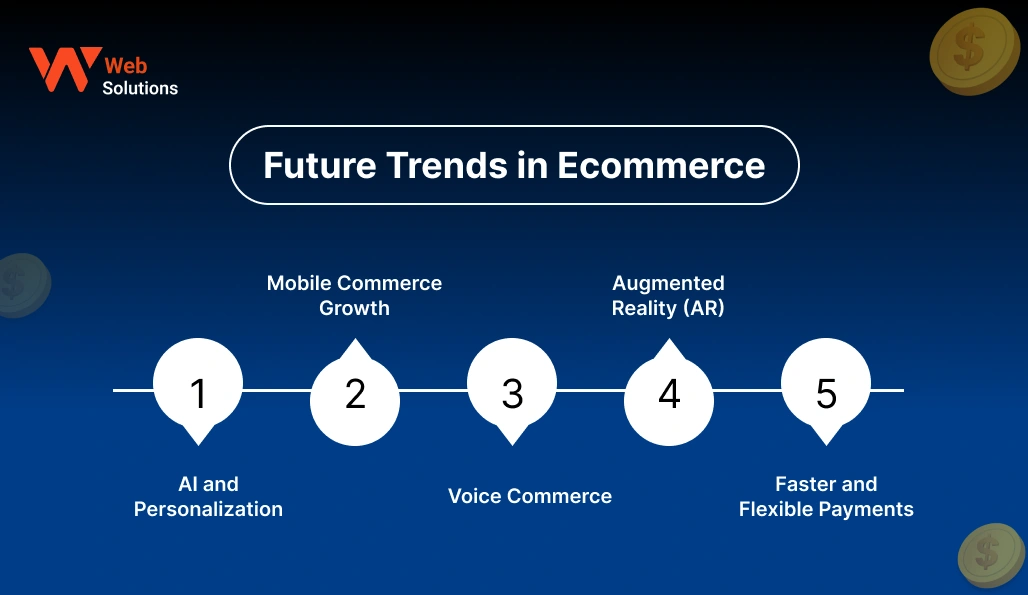
The future of the ecommerce website industry is rapidly evolving with new technologies and changing customer behavior. Businesses are focusing on innovation to enhance the online shopping experience, improve customer engagement, and stay competitive in the growing ecommerce development landscape.
1. AI and Personalization
Artificial intelligence is playing a major role in modern ecommerce websites by enabling personalized product recommendations, smart chatbots, and predictive analytics. These tools help businesses understand user behavior, offer relevant products, and create a more engaging and customized shopping experience.
2. Mobile Commerce Growth
The rise of smartphones has made mobile ecommerce websites more important than ever. Businesses are optimizing their platforms for mobile devices and developing apps to ensure fast loading, easy navigation, and seamless checkout experiences for users on the go.
3. Voice Commerce
Voice technology is becoming a key trend in ecommerce development, allowing users to search and shop using voice commands through smart assistants. This makes the shopping process faster, hands-free, and more convenient, especially for mobile and smart home users.
4. Augmented Reality (AR)
Augmented reality is transforming the online shopping experience by allowing customers to visualize products in real-time before purchasing. Whether it’s trying on clothes or previewing furniture, AR helps reduce uncertainty, increase confidence, and lower return rates.
5. Faster and Flexible Payments
Modern ecommerce websites are integrating advanced payment solutions such as UPI, digital wallets, and buy-now-pay-later options. These methods make transactions quicker, more secure, and convenient, improving customer satisfaction and increasing conversion rates.
Also, read: eCommerce Web Solutions: Features, Tech Stack & Best Practices
Conclusion
Creating an ecommerce website is a strategic investment that can significantly boost your business growth, expand your reach, and enhance customer experience. From understanding the cost structure to choosing the right platform, features, and design, every decision plays a crucial role in building a successful online store.
As the ecommerce industry continues to evolve with trends like AI, mobile commerce, and advanced payment solutions, businesses must stay updated and invest in scalable, future-ready solutions. Whether you are a startup or an established brand, having a well-developed ecommerce website is essential to stay competitive in today’s digital market.
If you’re looking to build a high-performing and scalable ecommerce website, Web Solutions LLC offers expert ecommerce development services tailored to your business needs. With a focus on quality, innovation, and long-term growth, they help turn your ideas into powerful digital experiences that drive results
FAQs
1. How much does it cost to create an ecommerce website?
The cost of creating an ecommerce website typically ranges from $250 to $25,000+, depending on the complexity, features, platform, and development approach. Basic websites are more affordable, while advanced custom solutions require higher investment for scalability, performance, and long-term business growth.
2. Which platform is best for building an ecommerce website?
The best platform depends on your business needs and budget. Shopify is ideal for beginners due to ease of use, WooCommerce offers flexibility and affordability, while custom development is best for businesses requiring advanced features, scalability, and complete control over design and functionality.
3. How long does it take to build an ecommerce website?
The development time varies based on complexity and features. A basic ecommerce website can take 2–4 weeks, while mid-level websites may take 1–3 months. Advanced or custom ecommerce platforms can take 3–6 months or longer, depending on requirements and integrations.
4. What features are essential for an ecommerce website?
Essential features include a product catalog, shopping cart, secure checkout, payment gateway integration, user accounts, and order tracking. These features ensure smooth navigation, secure transactions, and a seamless shopping experience, which are critical for improving customer satisfaction and boosting conversions.
5. Do ecommerce websites require ongoing maintenance?
Yes, ecommerce websites require regular maintenance to ensure security, performance, and functionality. This includes updating software, fixing bugs, improving speed, and applying security patches. Ongoing maintenance helps prevent issues, enhances user experience, and ensures your website runs smoothly as your business grows.