CMS Web Solutions: How to Choose Between WordPress, Drupal & Custom CMS
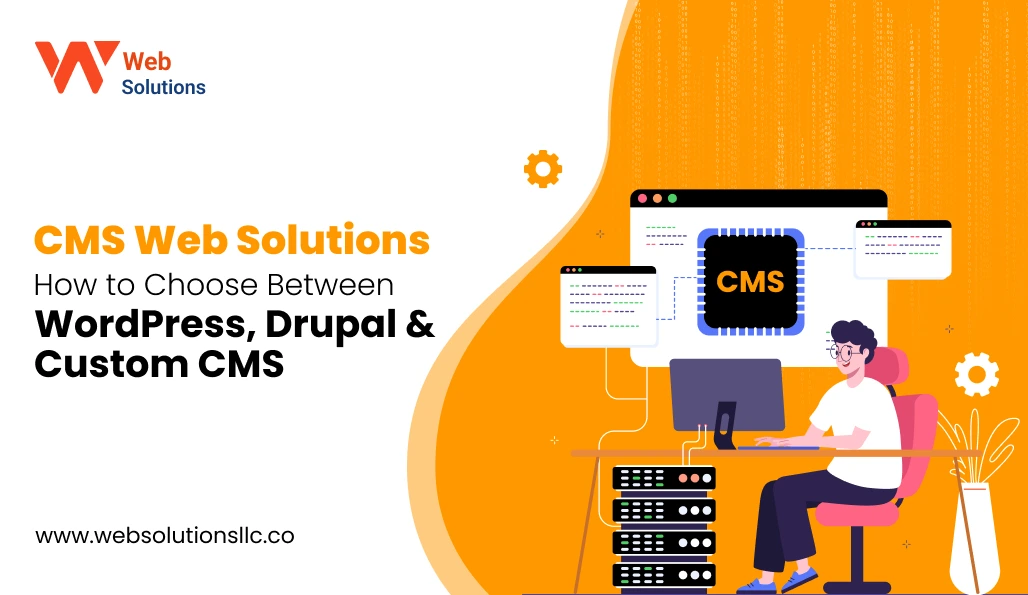
Regardless of their size, businesses have to operate online in a strong and properly managed way if they want to survive. Customers are now demanding digital experiences without any friction, and, in most cases, the website of a company is their first contact with it. To be able to satisfy these demands, companies have to be equipped with systems that will give them the freedom to manage, update and develop their websites in a convenient way. The rise in the adoption of CMS Web Solutions is the result of such a necessity.
Content Management System (CMS) is software that offers a framework and instruments for the supervision of a website’s content without the need of constant developer intervention. It changes the everyday management into something easier, enables more rapid updates, and allows businesses to change their sites in the course of the development of their strategies. For companies that are considering the Web Solutions Services professionally, the selection of a CMS is not merely a technical decision; it has a direct impact on performance, security, workflow efficiency, and digital growth in the long run.
Presently, the three main options for handling modern websites; WordPress, Drupal, and Custom CMS solutions; have become the top contenders for the role of a platform where sites are managed. The main advantages of each of these are designed for different priorities, such as user-friendliness, security at the level of a large enterprise, or absolute customization. The right CMS can be a powerful tool for achieving digital goals and business growth, whereas the wrong one may result in the emergence of limitations and higher maintenance expenses.
This blog thoroughly evaluates these alternatives and provides the necessary information to figure out what kind of CMS will be the best fit for your organization’s requirements.
- CMS Web Solutions gives organizations the power to handle their websites effectively without having to rely on developers.
- WordPress is perfect for companies that are looking for an economical solution that is easy to use and has a fast deployment together with marketing-friendly features.
- Drupal is an excellent fit for corporations that are after highly secure systems, progressive workflows, and intricate content structure.
- Custom CMS provides complete flexibility and ownership for firms that require specific features and plans to grow over time.
- The right CMS lowers maintenance costs, enhances growth, and boosts digital performance, while the wrong choice imposes limitations that last for a long time.
- CMS platforms provide businesses with content management, workflow automation, and quick website updates, thus being very important for digital presence and customer experience.
- WordPress offers small to medium businesses easy installation, powerful plugins, and quick marketing implementation as its main advantages, even if it sometimes needs surveillance in terms of security.
- Drupal is primarily used in sectors that value security, user access control, and structured content, such as government, finance, and healthcare, where it is still being used.
- A Custom CMS gives the organizations the possibility to create original functionalities that are integrated with their internal operations and do not rely on any external tools or plugins.
- Choosing a CMS is a tactical decision made under the influence of numerous factors like price, need for scalability, difficulty of content, and digital objectives for the long term.
- Working with a web solutions company guarantees the selection of the right platform, maximum possible configuration, and easy integration with the existing enterprise systems.
What Are CMS Web Solutions?
CMS Web Solutions are digital platforms aimed at helping businesses in creating, managing, and publishing website content without the requirement of coding a custom solution or having technical knowledge. These solutions offer a centralized interface through which users can manage website elements, automate workflows, and install new features quickly, thus making website management faster, more scalable, and less costly. Such systems are at the core of the modern web activities of companies that depend on professional Web Solutions Services, thus allowing them to have smoother digital growth and better user experiences.
- No Coding Needed: Non-technical users are allowed to handle and update the website content easily.
- Versatile Content Management: The addition, deletion, and alteration of pages, blogs, media, and product listings are all supported.
- Access Based on Roles: Companies can manage the access rights and the editorial processes of different employees.
- Smooth Integrations: The link with CRM, ERP, analytics platforms, and marketing tools not only helps but also improves the overall efficiency.
- Uniformity of Brands: The same design, content standards, and messages are kept across all digital assets.
- Flexible Base: It is a growing website, increasing traffic, and developing new features as business needs change.
- Professional Setup: A professional web solutions company is capable of customizing, securing, and optimising a CMS according to the specific goals of an organization.
WordPress vs. Drupal vs. Custom CMS: Detailed Comparison
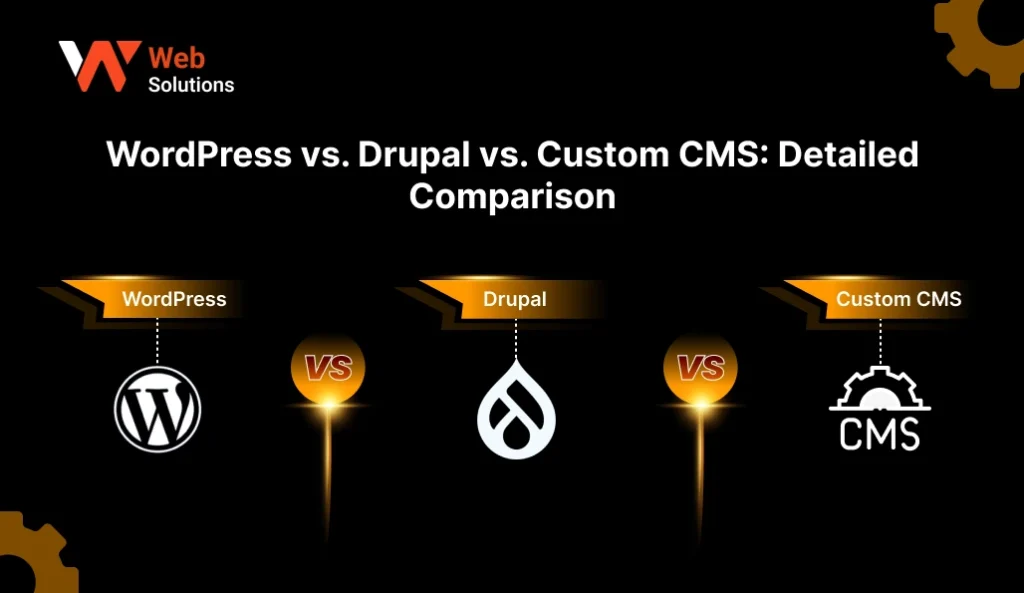
While selecting a CMS platform, one must consider their business goals, technical specifications, and overall digital strategy. Even though WordPress, Drupal, and Custom CMS are the top three most widely used, their individual advantages and disadvantages vary greatly in the areas of user-friendliness, scalability, customization, and security. Knowing their differences inside out is important because the CMS you pick will be a major factor in your site’s efficiency, the costs of the development, and the changes made.
WordPress has gained popularity as the easiest, most user-friendly, and fastest-to-set-up CMS. As such, it has become the safest bet for small- to medium-sized businesses and those who want a marketing-centered website. On the contrary, Drupal is very much appreciated for its security, content management with a strict structure, and excellent ability to grow that are all factors contributing to its use by large companies, government bodies, and medical-related businesses that deal with sensitive data. Custom CMS, in the meantime, is a software system specially designed from scratch and according to the company’s own workflows and requirements, which can be proprietary. It is usually hardly ever less costly; however, it does offer absolute power, adaptability, and creativity without boundaries.
The table below provides a clear comparison to help you identify which CMS aligns best with your strategic goals:
| Feature | WordPress | Drupal | Custom CMS |
| Ease of Use | Beginner-friendly | Moderate learning curve | Depends on developers |
| Security | Good with proper practices | Enterprise-grade | Fully customizable |
| Cost | Low to medium | Medium to high | High |
| Scalability | Strong for SMBs | Excellent for enterprises | Unlimited |
| Customization | High via plugins | Very high via modules | Unlimited |
| Time to Deploy | Fast | Moderate | Long |
| Best For | Blogs, corporate sites, SMBs | Government, enterprises | Unique system requirements |
WordPress – The Most Adopted CMS Web Solution
WordPress is still the most widely used CMS, and thus it is the engine behind a good part of the global websites. Organizations that want to set up their digital presence quickly and then go for strong deployment usually prefer WordPress because of its ease of use and versatility.
Reasons to Choose WordPress
- Extensive plugin ecosystem
- User-friendly admin interface
- Strong SEO plugin support
- Affordable development and hosting options
- Large community and documentation base
Ideal Use Cases
- Small to medium businesses
- Content-driven platforms such as blogs or magazine sites
- eCommerce websites (via WooCommerce)
- Marketing-oriented landing pages
- Service-based business websites
Advantages of WordPress
- Short development timelines
- Cost-effective for startups
- High design flexibility through themes
- Easy integration with marketing automation and CRM tools
Limitations of WordPress
- Over-reliance on plugins may affect security
- Requires optimization for high-traffic environments
- Some enterprise use cases require customization beyond plugins
When WordPress Is the Best Fit
- When you want fast results
- When marketing teams manage frequent updates
- When budgets are restrained but scalability matters
Drupal – The Secure and Scalable CMS for Enterprises
Drupal is developed for complicated, extensive, multilingual environments where detailed control is crucial. It is commonly used by government, academic and corporate institutions that impose stringent security measures.
Reasons to Choose Drupal
- Built-in role-based access system
- Multi-site and multilingual capabilities
- Highly secure, regularly audited codebase
- Great for structured content and workflow mechanisms
Ideal Use Cases
- Government and public sector portals
- Healthcare and fintech platforms
- Academic institutions and media organizations
- Platforms requiring multi-level permissions
Advantages of Drupal
- Superior security and access control
- Modular architecture for advanced workflows
- Ability to handle massive data without performance degradation
Limitations of Drupal
- Requires specialized developers
- Higher development and maintenance costs
- Not ideal for businesses without technical personnel
When Drupal Is the Best Fit
- When security is paramount
- When you manage multiple users and content workflows
- When you require a complex, structured platformRead more: How to Get Affordable Web Solutions Without Breaking the Bank
Custom CMS – Built for Innovation and Ownership
A Custom CMS, in contrast to WordPress and Drupal, is built from the ground up. It offers total personalization and digital assets that are in line with the specific goals of your business and are not subject to obsolescence.
Reasons Companies Choose Custom CMS
- Full ownership of the codebase
- No dependency on open-source modules
- Tailored functionalities for industry-specific processes
- Optimized for performance and security requirements
Ideal Use Cases
- SaaS products and subscription platforms
- Logistics, AI-based recommendations, and IoT systems
- Businesses requiring proprietary workflows
- Enterprise-grade, closed systems with compliance needs
Advantages of Custom CMS
- Completely flexible architecture
- No unnecessary features or plugin bloat
- Integrates seamlessly with internal and external systems
Limitations of Custom CMS
- Higher upfront investment
- Longer development cycles
- Requires an experienced web solutions company
When Custom CMS Is the Best Fit
- When innovation, unique workflow, or proprietary digital infrastructure is the goal
- When business logic cannot be replicated using standard platforms
- When control and customization are long-term priorities
Quick Decision Table
| Business Requirement | Recommended CMS |
| Small business website | WordPress |
| High-security enterprise | Drupal |
| Proprietary product or SaaS | Custom CMS |
| Frequent marketing campaigns | WordPress |
| Multi-site corporate network | Drupal |
| Custom digital ecosystem | Custom CMS |
Key Factors to Consider Before Selecting a CMS
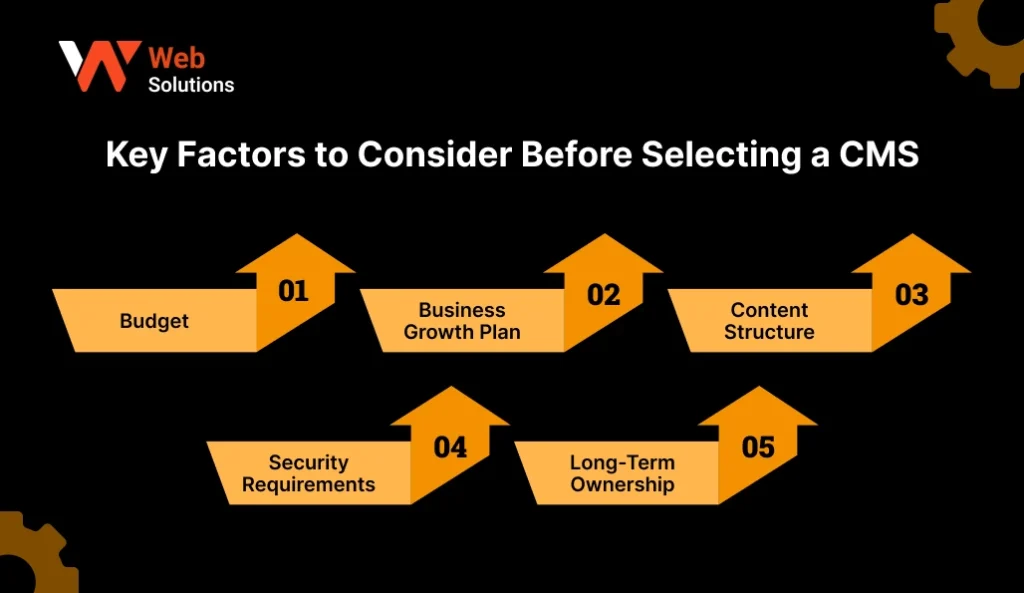
Comparing features is just one aspect of choosing the right CMS. The decision must be made according to business aims, technical requirements, security issues, and future expansion. By looking at these factors, you can be sure to pick a way that goes along with your digital strategy and does not restrict your possibilities.
1. Budget
In your budget lies the definitive line between the level of customization, scalability, and support you can count on. For the majority of organizations, WordPress is a budget-friendly option; on the other hand, a Custom CMS requires a substantial investment, as it involves development to meet specific needs. Think about not just the upfront but also the long-term costs of maintenance and upgrades.
2. Business Growth Plan
Your CMS must support future expansion. If you anticipate rapid growth, evolving customer needs, or new digital services, select a platform built for scalability. Drupal and Custom CMS options are better suited for complex architectures that can accommodate significant upgrades without performance constraints.
3. Content Structure
Structured content, taxonomy management, and modular workflows are the necessities of complex websites. Drupal is handling complex content models and performing at its best in large environments with big data. In contrast, WordPress is more suitable for marketing-oriented sites where constant updates, blogs, and promotional pages are the main focus of the site.
4. Security Requirements
It should be emphasized that each industry has its own set of standards regarding compliance and security. Areas that handle sensitive data must, first of all, look for platforms that have top-notch security features. As a result, Drupal is the winner in such scenarios, whereas if a person decides to use WordPress, he will have to be more careful to make sure that there are no security holes and that his plugins have not been tampered with.
5. Long-Term Ownership
Ownership affects flexibility, control, and sustainability. Custom CMS solutions eliminate dependency on third-party tools, licensing limitations, or plugin ecosystems. Businesses looking for full autonomy over updates, integrations, and security prefer Custom CMS frameworks designed specifically to match their operational and growth roadmap.
Why Work With a Professional Web Solutions Company
Selecting and implementing a CMS requires structured planning. A professional provider of Web Solutions Services helps you:
- Analyze business workflows
- Recommend the most suitable CMS platform
- Customize themes and modules for branding
- Integrate CRM, ERP, and legacy applications
- Establish hosting, security, and compliance standards
- Maintain and update the system over time
Their expertise ensures your CMS investment becomes a strategic digital asset rather than a temporary website.
Conclusion
The CMS you select now is what will define how flexible and competitive your digital ecosystem will be in the future. WordPress allows for fast development and marketing to be in sync. Drupal provides very strong enterprise governance, security, and content structure. A custom CMS gives you total freedom and is full of creative possibilities, a great fit for a business that is aiming to be digitally dominant.
No answer is always correct; it is only the CMS that fits your operational requirements, development strategies, and financial resources that can be considered right. The most critical factor is to pick a solution that will be an ally rather than an obstacle to your dream. Once the technological competence is in line with the business strategy, your CMS becomes the heart of your triumphant digital transformation.
FAQ
1. Which CMS offers the best SEO capabilities?
WordPress is a good platform for SEO beginners through plugins and easy-to-use optimization tools that can be handled by a marketing team or a single user. On the other hand, Drupal has more sophisticated, technically stronger SEO features that are designed for large-scale websites with the need for detailed control.
2. Can I migrate from WordPress to Drupal or a Custom CMS?
Yes, migrating can be done and doesn’t have to result in a loss of important data. If it’s a well-planned migration under the management of an expert web solutions company, the change will keep your URLs, content structure, page authority, and SEO rankings going with the flow.
3. Which CMS is the most secure?
Drupal is widely regarded for its enterprise-grade security standards and is frequently used by government agencies and regulated sectors. A Custom CMS can offer even stronger security if developed with rigorous protocols, as it eliminates vulnerabilities associated with publicly available plugins and themes.
4. How do I decide which CMS to choose?
Could you define your priorities, budget, scalability, security expectations, content complexity, and long-term digital plans? If the decision is unclear, seeking guidance from specialists offering Web Solutions Services can help align your CMS selection with your operational and strategic goals.
5. Is a Custom CMS worth the investment?
Yes, for businesses needing specialised workflows, proprietary features, or full control over digital infrastructure. A Custom CMS offers unmatched flexibility and future-proofing, making it a valuable long-term investment for organisations aiming to build scalable, differentiated digital platforms.