The Cost of Startup Web Solutions: Budgeting for Your First Website
Starting a business today without a website is similar to opening a store without a signboard. In a digital-first world, your website acts as the brand identity of your company, the sales engine, and the customer support system. It enables new customers to know what you offer, establishes trust, and increases sales at any hour. However, the majority of business owners are stuck at the very first step, deciding how much a website actually costs.
Knowing the pricing of a website is a must since the money spent on it can be different depending on your design choices, the features that you need, and the kind of development solutions for the website that you will take. Today, with a varied list of Web Solutions Services ranging from simply informational sites to fully scalable platforms, each startup has to make sure that its budget is in line with its growth plan for the future. Choosing the right web solutions company can make the difference between a website that simply exists and one that actively generates revenue.
This blog explains the true costs of startup web solutions, the factors that influence pricing, and how to budget wisely without overspending.
TL;DR
- Startup web solutions turn your website into a digital growth engine.
- They are instrumental for companies to create trust, draw in clientele, and simplify working procedures.
- Properly chosen features and layout turn websites into more potent tools than simply digital brochures.
- An effectively designed site is an integral part of a company’s marketing, branding, and lead generation activities for the future.
- With a website, you can be at the core of your online presence and the growth of your business.
Key Points
- Startup websites offer businesses a valid digital identity through which the customers can easily trust and interact with the brand from the very first time.
- Such features as custom UI/UX, payment systems, dashboards, and CRM integrations elevate a website to the level of a tool for conversions, automation, and customer management.
- The price of website development is dependent on different factors such as complexity, features, and scalability needs and thus can be as low as that of a simple informational site or as high as that of a full SaaS platform.
- Putting 10%–20% of your marketing budget into the website will make it a long-term asset rather than a temporary cost.
- By selecting a trustworthy web solutions company, you can get the support, hosting, updates, and maintenance that will enable your site to develop like your business and stay competitive.
Website Development Cost Breakdown
Startup site expenditure is highly variable, as it depends on the features, the complexity of the design, and the development platform. In general, you could incur the following charges:
| Website Type | Ideal For | Core Features | Estimated Cost Range (CAD) |
| Basic Informational Site | Early-stage startups, service providers | Home, About, Services, Contact | C$320 – C$960 |
| Custom Business Website | Growing businesses needing branding | UI/UX design, CMS, blog, forms | C$960 – C$2,400 |
| E-commerce Store | Product-based startups | Product listings, payment gateways, tracking | C$1,600 – C$7,200 |
| Web App / SaaS Platform | Tech startups | User accounts, dashboards, automation | C$3,200 – C$24,000+ |
Such forecasts make it possible for you to align your financial plan with the range of startup website development options through the projections. In the following section, a more comprehensive description of each category is given.
1. Basic Informational Website (C$320 – C$960)
This would be the most inexpensive and easiest method for a startup to establish its existence on the internet without having to use a lot of features.
What you get:
- A professional fixed or CMS-powered website.
- Standard pages such as Home, About, Services, Blog, and Contact form.
- Basic branding elements like logo placement and color themes.
- Suitable for consultants, small businesses, freelancers, and single-service providers.
Why choose it:
It is ideal if your priority is credibility and visibility rather than automation or sales.
2. Custom Business Website (C$960 – C$2,400)
This is a step up from basic sites and focuses on unique branding and user experience.
What you get:
- Custom UI/UX design to correspond with your brand identity
- Content Management System (CMS) to enable easy modifications
- Complex forms, FAQ sections, landing pages, and blogs
- Incorporation with important marketing tools like email automation and analytics
Who needs this?
Startups that aim to convert traffic into leads, build trust, and scale online operations.
Also Read: CMS Web Solutions Guide
3. E-commerce Store (C$1,600 – C$7,200)
Designed for selling products or subscriptions online with secure transactions.
What you get:
- Product catalog and search filters
- Payment gateways (Credit/Debit Cards, UPI alternatives, Wallets)
- Order tracking, inventory management, and shipping integrations
- Promo codes, wishlists, customer profiles, and reviews
Why it costs more:
It requires more database management, security, payment compliance, and backend logic.
4. Web App / SaaS Platform (C$3,200 – C$24,000+)
This is the most advanced type of startup web solution. It offers real-time interactions and user-specific dashboards.
What you get:
- User registration and login systems
- Role-based dashboards and customized workflows
- Data analytics, automation, reports, and cloud integration
- API development and mobile app integration options
Who chooses this?
Technology-based companies creating scalable products such as educational apps, customer relationship management software, booking systems, fitness platforms, or artificial intelligence tools.
Why it’s expensive:
It also includes the use of various technologies such as advanced development frameworks, database engineering, security layers, cloud architecture, and continuing maintenance.
How Much Should a Startup Budget?
A realistic startup website budget is between CAD 800 and CAD 4,700 approximately. The price varies depending on the kind of digital presence you’d like to have. A bare-bones site with the essential pages and a handful of features will be priced at the lower end of the range. On the other hand, a feature-packed, scalable digital ecosystem such as an e-commerce platform or a SaaS product requires a higher amount of money because of the considerations for the design, development, integrations, and scalability for the long run.
Start-up founders at the seed stage should consider a website as one of the main business assets rather than just an additional cost. A properly designed site becomes the lever for marketing, customer acquisition, brand building, and future automation. It is, in fact, the very first point of contact with potential customers, investors, and partners.
Therefore, experts advise you to set apart 10%–20% of your marketing budget for the creation of your website. By doing this, you are not underinvesting in what will be your main digital conversion channel. An excellent website increases the company’s trustworthiness, SEO, and lead generation efforts, and it is cost-effective in the long run as it avoids frequent redesigns or platform migration.
In simple terms:
- Firstly, use the money sensibly if you want to keep the same business and only if necessary.
- Don’t only align your budget with what you need right now, but also with your business goals.
- Think of the site as a machine that fuels the business rather than just another expense.
If you handle your money in a smart way, your site will be able to show the business changes and will be a great tool to attract new customers by marketing campaigns, product launches, customer service systems, and brand growth over time.
Key Factors That Influence Website Pricing
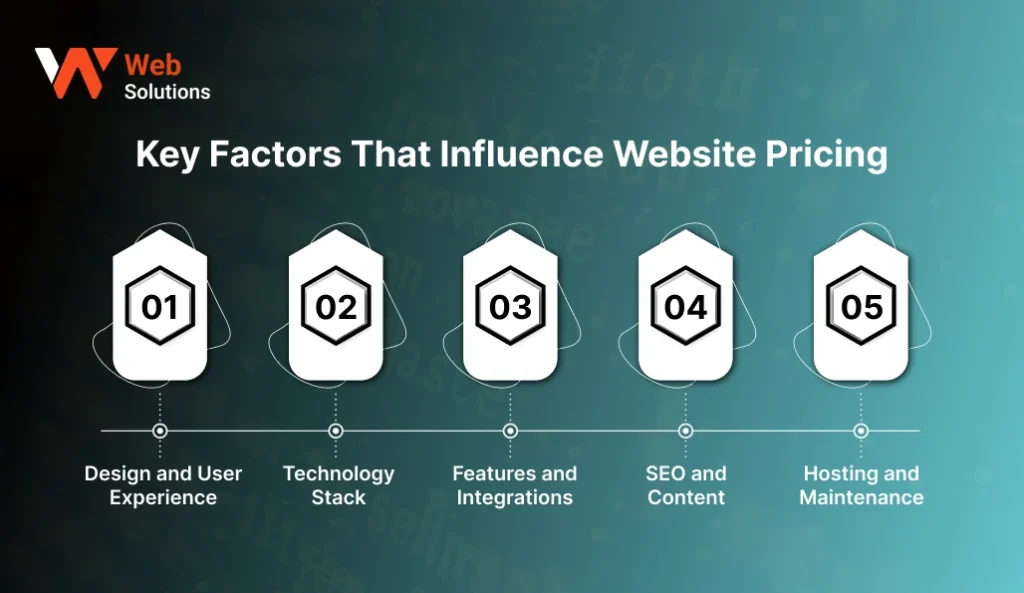
Creating a website is not a standardized type of investment. How much the website will cost in the end is a matter of various elements that determine the complexity, functionality, and how long the site can be used. Just to name a few, these are the main factors that have an immediate impact on the price.
1. Design and User Experience
Your website’s look and feel determine how users perceive your brand. A basic template-based design costs less but offers limited customization. In contrast, a custom UI/UX design:
- Involves brand-aligned layouts, typography, and colour schemes
- The process of wireframing, prototyping, and designing user interaction flows is essential.
- It also leads to increased visitor engagement, trust, and ultimately, higher conversion rates.
It takes a lot of time for proficient designers to create a one-of-a-kind interface; hence, custom websites are usually more expensive. If the identity of your brand is important, then it is a must to invest in UI/UX.
Also Read: Custom Web Solutions vs Template Websites
2. Technology Stack
The tools, frameworks, and platforms chosen for development directly impact pricing.
- Open-source platforms such as WordPress not only come with a low price tag but also offer the right features for informational websites or small enterprises.
- On the other hand, custom-coded setups with the use of React, Laravel, or Node.js have the advantages of being flexible, scalable, and of high performance; however, they still need more time and more expert skills.
If your project demands real-time data handling, user dashboards, or mobile app integration, you will likely need a more advanced tech stack. increasing the cost.
3. Features and Integrations
The number and complexity of features significantly affect the budget. Basic websites need only static pages, but advanced sites require additional functionalities, such as
- Payment gateways
- CRM tools like HubSpot or Zoho
- Chatbots and live-support systems
- SMS/email alerts
- Inventory management
- Third-party APIs
Each integration requires configuration, testing, and ongoing support. The more automation and user interaction your site needs, the higher the development cost.
4. SEO and Content
What’s the point of a website if it is nowhere to be found? This is exactly where SEO and content strategy play their part.
- Content that is rich in keywords and optimized is what makes a website rank higher on search engines.
- To attract more visitors through blogs, websites, and product pages, along with the metadata, skilled writing is necessary.
- There will be an additional charge if you want to do technical SEO work like speed optimization, schema markup, and creating sitemaps.
While many startups ignore SEO initially, it is one of the most valuable investments if you want organic traffic and long-term growth.
5. Hosting and Maintenance
After launch, your website needs continuous care. Costs don’t stop with development.
Maintenance includes:
- Hosting server charges (cloud hosting is recommended for scalability)
- Regular software updates and bug fixes
- Security enhancements, SSL certificates, and backups
- Performance monitoring and optimization
Neglecting maintenance can lead to website downtime, cyber-attacks, or data loss — all of which are more expensive to fix later.
Why Startup Web Solutions Matter
A well-built website does more than display information. Modern Web Solutions Services are designed to:
- Establish brand credibility from day one
- Convert visitors into leads or customers
- Integrate essential tools like payments, chatbots, CRMs, and analytics
- Scale as your business grows
Choosing the right web solutions company ensures your website becomes a long-term digital asset, not a one-time cost.
Smart Tips to Save Money Without Compromising Quality
- Start small and scale later
- Choose a reputable web solutions company rather than the cheapest quote
- Use a CMS to manage content independently
- Focus on essential pages such as Home, Services, About, Contact
- Opt for cloud hosting rather than shared hosting for long-term stability
Why Website Development Solutions Are a Long-Term Investment
A well-planned website:
- Drives leads continuously
- Reduces customer service load
- Enhances brand trust
- Supports future digital marketing, SEO, and automation
Your first website shapes customer perception. Investing wisely prevents costly redesigns as your startup grows.
Conclusion
New business entrepreneurs should view the creation of a website as an investment rather than a cost, and this investment will bring business growth to them eventually. Currently, startup web solutions are vital for building brand identity, getting customers, and carrying out business operations that can be scaled. Your business, through a well-designed website, can be made different; the website can attract visitors and convert them into leads, and it can support your marketing activities in the future.
If you want just a few pages of a site to provide information or a complete digital platform, knowing your budget in advance will enable you to make a feature prioritization and have the customer feature investment. By having the right mindset and working with a trustworthy web solutions provider, your website turns into a valuable tool that brings you measurable growth and a competitive edge.
FAQs
1. How much does it cost to build a startup website?
The price that is charged varies based on the design, features, and technology used. For example, a basic website could be cheaper, whereas a custom platform, e-commerce site, or SaaS solution would need to be more expensive for their complex functionalities and integrations.
2. Do I need a custom website, or is a template enough?
Templates are appropriate for nascent companies that have restricted requirements. If a distinct brand identity, cutting-edge functionalities, or future-proof scalability are your desires, then going for custom website development is a more feasible option.
3. How long does it take to develop a website?
Different time spans are required in order to create a website. For instance, a simple website can be done in between one and four weeks. On the other hand, custom business websites, e-commerce sites, or SaaS solutions can take a few months depending on how complex they are and how many changes have been made.
4. Is website maintenance necessary after launch?
Indeed. Web pages require regular updating, security patches, hosting, backups, and performance verifications. Maintenance carried out routinely safeguards your information and provides a pleasant user interaction.
5. Can I scale my website in the future?
Absolutely. Modern Web Solutions Services allow you to add features like payment gateways, CRM tools, automation, and mobile apps as your startup grows, making scalability simple and cost-effective.