PHP Web Development in 2026: Trends, Tools, and Best Practices

PHP sites are still everywhere, and many business teams still bet on them. PHP web development keeps running login portals, dashboards, ecommerce stores, and busy content sites that cannot afford downtime.
Statista’s worldwide developer survey puts PHP at about 18.2% usage among developers. That number may not sound flashy, but it shows something important. PHP is still a daily tool for a big slice of working teams. On the web itself, PHP also powers a large share of sites where the server-side language is known.
So the real question in 2026 is not “Should PHP be used?”. The real question is who builds it, and how clean the code stays after launch. This is where Web Solutions Services from the right team make a real difference, because support, fixes, and upgrades decide if your site stays stable or turns into a patchwork. A good PHP development company will keep performance, security, and updates steady, so the site does not become a patchwork after six months.
This blog will cover PHP history in simple words, why PHP still makes sense, top 2026 trends, top frameworks, cost, the future of PHP, and clear FAQs.
TL;DR
- PHP is still used for serious business websites in 2026.
- Modern PHP work is more about clean code, testing, and safe updates.
- Trends are moving toward API-first builds, caching, containers, and better monitoring.
- Framework choice decides speed, structure, and long-term maintenance.
- Real cost depends on scope, integrations, security, and support after launch.
Key Points
- PHP continues to power portals, dashboards, ecommerce flows, and content-heavy sites where downtime is costly.
- In 2026, strong builds focus on performance, security checks, and repeatable releases, not just adding new features.
- Many teams now design the backend as an API layer so the same system can serve a website, app, and admin panel.
- Caching, queues, and background jobs help keep user actions fast even when traffic spikes.
- Containers and automated testing reduce “works on my machine” issues and lower risk during frequent updates.
- Frameworks like Laravel and Symfony suit different needs, so picking the right one early saves rework later.
- Budget planning improves when MVP scope is tight, integrations are decided early, and post-launch support is included.
A Brief History of the PHP Language
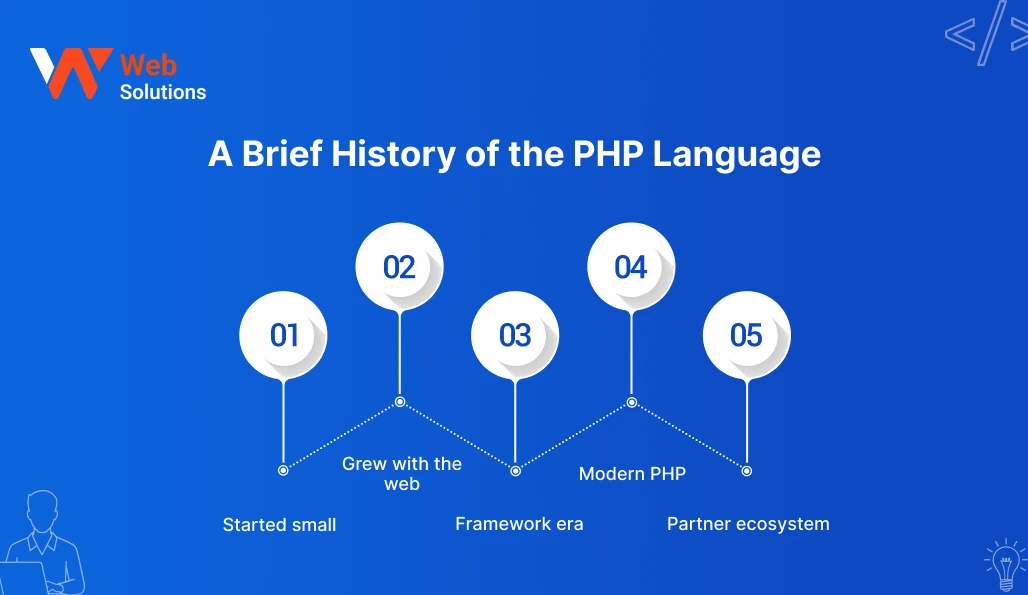
PHP started in the mid-1990s as a simple way to make web pages dynamic. Instead of only showing fixed text, websites could take input, save data, and show different results for different users. Over time, PHP became a full server-side language used for logins, forms, admin panels, and ecommerce. It also grew up. New versions improved speed, security, and code structure. Frameworks and modern coding standards made long projects easier to maintain. That is why PHP web development still shows up in many business sites today.
- Started small. It began as a basic tool for adding dynamic parts to personal websites. This made simple sites feel interactive.
- Grew with the web. As forms, logins, and database work became common, PHP fit naturally. It helped teams ship useful features faster.
- Framework era. Frameworks brought better structure and reusable patterns, so projects stayed cleaner. This improved delivery for many PHP development services teams.
- Modern PHP. Updates improved performance and security, so sites run smoother. Many PHP web development solutions now feel more stable and maintainable.
- Partner ecosystem. A strong PHP Development Company can add reliable PHP web services and long-term support. That is what makes PHP web development services easier to run after launch.
Why PHP Web Development Is Still a Smart Choice in 2026
PHP is still a smart pick because it solves common business needs without making things heavy. Many websites need forms, logins, admin panels, content pages, and payment flows. PHP handles these well. Hosting is widely available, and teams can usually hire developers faster compared to niche stacks. Modern versions are also faster and safer than the old image people carry. If the code is written cleanly, updates and feature additions stay manageable. That matters in 2026, when sites need regular changes, not one-time builds. This is why PHP web development still fits business portals, ecommerce, and service websites.
- Easy to maintain. Clean structure keeps fixes simple. Small updates do not break the whole site.
- Cost stays predictable. Hosting and setup are straightforward. Long-term upkeep is easier to plan.
- Strong ecosystem. Mature libraries and frameworks reduce rebuild work. Common features ship faster.
- Good for real business work. Logins, dashboards, and CMS flows are natural fits. This is where PHP development services add real value.
- Safer when done right. Modern security practices are well-known. Regular updates keep risk lower.
Top 10 PHP Trends to Watch in 2026

In 2026, PHP web development is less about “just building pages” and more about running stable systems. Teams want faster performance, safer releases, and fewer surprises after launch. The web is also more connected now. Apps, dashboards, and partner tools need clean APIs. And every update needs testing, security checks, and monitoring. These trends show what modern builds look like today, and what a strong web solutions company should already be following while delivering PHP development services and long-term PHP web development services.
1. PHP 8.x Adoption Is Now the Default
Most new builds use PHP 8.x as the standard base. It brings better performance and more modern coding features, so projects feel cleaner and easier to maintain. It also improves compatibility with newer frameworks and packages. For businesses, this means fewer upgrade headaches later and smoother security patching over time.
2. Faster Performance With OPcache and Smarter Caching
Speed is not only for SEO. It also affects checkout drop-offs and user trust. Teams are using OPcache and layered caching to reduce repeat work on the server. This improves load time and reduces hosting pressure during traffic spikes. It is now a normal expectation in PHP web development solutions, not an optional extra.
3. API-First Builds for Apps and Websites
Many teams now design the backend as a clean API layer first. That API then powers the website, mobile app, admin panel, and integrations. This makes future expansion easier without rewriting core logic. Many PHP web services are built this way because it keeps systems reusable and less tied to one UI.
4. Smaller Services Instead of One Big Monolith
Large codebases become slow to change and risky to deploy. So teams are breaking key parts into smaller services, like payments, notifications, or reporting. This makes updates safer and helps scale only the heavy parts. It also reduces the chance of one change breaking the entire platform during peak hours.
5. Docker and Containers Used in Day-To-Day Work
Day-to-day development is moving toward consistent environments. Containers reduce setup differences across machines and servers. This lowers the “it worked on staging” problem. It also makes onboarding new developers faster, which matters when teams grow or projects expand.
6. Automated Testing on Every Update
Manual testing alone does not protect live systems. More teams now run automated checks for login, cart, payments, and key user flows. Even basic test coverage catches issues early and prevents silent breakage. This is a must for steady PHP web development services, where updates happen often and downtime is costly.
7. Stronger Security Checks for Packages and Code
Security is becoming more proactive. Teams are scanning dependencies, tracking vulnerabilities, and tightening code review rules. Many issues come from outdated packages, not only from custom code. A reliable PHP Development Company will treat security as a routine step, not as a last-minute add-on.
8. More Queues and Background Jobs for Heavy Tasks
Heavy jobs should not slow down user actions. Tasks like email sending, invoice generation, report exports, and data sync are moved to background queues. This keeps pages fast and reduces timeout errors. It also improves reliability during peak usage, when systems are already busy.
9. Better Monitoring, Logs, and Alerts for Live Sites
Launch is not the finish line. Monitoring and alerts help detect issues before users complain. Better logs also help support teams find root causes quickly. This trend is important because businesses expect ongoing stability, not only a one-time build. Strong PHP development services include this operational layer by default.
10. More Headless CMS and Ecommerce Builds on PHP
More sites are separating content from the frontend experience. Content is managed in one place and used across websites, apps, and landing pages. This gives more flexibility for design changes and multi-channel publishing. Many modern CMS web solutions are moving here because it keeps content control strong while still allowing faster UI changes.
Top 10 PHP Web Development Frameworks in 2026

Frameworks keep projects organised. They save time because common things are already solved, routing, validation, security basics, and database patterns. In 2026, the “best” framework depends on what is being built. A small API needs speed and simplicity. A large portal needs strict structure and long-term stability. The good part is, modern PHP has strong options for both. Picking the right framework also affects cost, hiring, and how easy upgrades feel later. Many website development solutions stay healthy for years mainly because the right framework was chosen early.
1. Laravel
Laravel is a favourite for teams that want to ship fast without losing structure. It fits admin panels, customer portals, booking systems, and ecommerce-style projects. It also has a strong ecosystem, so common features like auth, queues, and notifications are easier to build. For many businesses, this makes delivery smoother and timelines more predictable. A solid PHP Development Company often picks Laravel when the goal is quick releases with clear code organisation and steady maintenance after launch.
- Best for. Full web apps with dashboards. Good for rapid builds.
- Why teams like it. Clean conventions and a strong ecosystem. Less boilerplate work.
- Watch-outs. Can feel heavy for tiny APIs. Needs a good hosting setup for scale.
2. Symfony
Symfony is known for strong architecture and long-term stability. It suits complex business systems where clean design matters more than speed of first launch. Many teams use Symfony components even outside Symfony projects, which shows how trusted it is. It works well when the app has many modules, roles, and integrations. For enterprise-grade PHP web development services, Symfony helps keep large codebases maintainable, especially when multiple developers work on the same system for years.
- Best for. Enterprise systems and complex workflows. Long-lived projects.
- Why teams like it. Modular components and clear standards. Easy to maintain at scale.
- Watch-outs. Steeper learning curve. Slower to start for small teams.
3. CodeIgniter
CodeIgniter is lightweight and simple to start with. It works well for smaller apps, quick MVPs, and projects where the flow is straightforward. The setup is not heavy, and learning time is shorter. That makes it useful when budget and speed matter. For a team offering PHP development services to small businesses, CodeIgniter can be a practical choice when the project does not need a large framework footprint, but still needs a clean structure.
- Best for. Small to mid-size apps. Quick builds with simple structure.
- Why teams like it. Easy to learn and fast to deploy. Less overhead.
- Watch-outs. Less opinionated structure. Complex apps need strong discipline.
4. Yii
Yii is often chosen for data-heavy apps and admin-first products. It supports quick CRUD development and can deliver solid performance when built with discipline. It is useful for internal tools, dashboards, and platforms where workflows are mostly database-driven. Yii can reduce build time for standard modules, which helps when timelines are tight. Many PHP web development solutions built on Yii work well when the requirements are clear and the team values speed plus structure.
- Best for. Admin panels and internal tools. Data-heavy apps.
- Why teams like it. Good code generation options. Strong performance focus.
- Watch-outs. Smaller community compared to Laravel. Fewer “plug and play” add-ons.
5. Laminas
Laminas is the modern continuation of the Zend ecosystem and is often used for enterprise work. It is component-driven and flexible, so teams can build systems exactly the way they want. This fits large platforms with complex integrations and custom architecture needs. Laminas can feel heavy for small projects, but it shines when code quality and modular design are priorities. A mature PHP Development Company may pick Laminas for long-term systems where change control and stability matter.
- Best for. Enterprise systems needing modular design. Complex integrations.
- Why teams like it. Strong components and customization. Good for long-term builds.
- Watch-outs. Requires experienced developers. Setup can feel heavy for small projects.
6. CakePHP
CakePHP is built around conventions, which reduces decision fatigue. It is useful for standard business web apps where many modules look similar, like users, roles, pages, and basic workflows. It helps teams move fast because structure is already defined. CakePHP also supports clean patterns for validation and database work. For steady PHP web development services, CakePHP can be a good fit when the product is not experimental, and the goal is a reliable build that stays easy to maintain.
- Best for. Standard business apps and portals. Quick CRUD workflows.
- Why teams like it. Clear conventions reduce decisions. Faster setup for common flows.
- Watch-outs. Less flexible for unusual architecture. Smaller ecosystem than Laravel.
7. Slim
Slim is a lightweight choice for APIs and small services. It does not force a full-stack approach, so it fits teams that want only routing and core request handling, then add what they need. This works well for microservices, internal APIs, and simple backend layers for mobile apps. Slim is often used when the focus is speed and minimal overhead. For projects that mainly deliver PHP web services, Slim can keep the setup lean and predictable.
- Best for. Lightweight APIs and micro services. Simple backend needs.
- Why teams like it. Minimal overhead and fast routing. Easy to keep lean.
- Watch-outs. Many features must be added manually. Not ideal for large full apps.
8. Phalcon
Phalcon is known for performance-first builds. It is often chosen when response time and efficiency are top priorities, like high-traffic APIs or systems under heavy load. It can be a good option when the infrastructure is tuned and the team knows the framework well. But hiring and community support can be smaller compared to popular frameworks. So Phalcon works best when a team already has experience and the project truly needs that performance edge in PHP web solutions.
- Best for. Performance-heavy apps. High request volume use cases.
- Why teams like it. Fast execution and efficient resource use.
- Watch-outs. Smaller community and ecosystem. Harder to hire for.
9. FuelPHP
FuelPHP is seen more in legacy systems and older projects, but it still appears in real-world maintenance work. It supports modular structures and can be useful when extending an existing system that already uses it. For brand-new builds, many teams prefer newer frameworks. But for upgrades, bug fixes, and adding modules to older platforms, FuelPHP remains relevant. This is where PHP development services often include legacy support work, not just new builds.
- Best for. Legacy-friendly builds. Modular app structures.
- Why teams like it. Supports modular design and clean separation.
- Watch-outs. Less active community. New projects may prefer newer options.
10. Spiral
Spiral is a modern framework focused on clean architecture and modular design. It is often chosen for API-first systems and apps that need clear separation of domain logic. Spiral can fit complex workflows where maintainability matters over the next few years, not just the first release. It is less common than Laravel or Symfony, so it needs a skilled team. For teams offering specialised PHP web development services, Spiral can be a strong choice when the project needs a structured, future-ready build.
- Best for. API-first systems and complex domain logic. Modular services.
- Why teams like it. Strong architecture focus. Good performance and scalability approach.
- Watch-outs. Smaller adoption compared to big names. Needs skilled developers.
Cost of PHP Web Development in 2026
Cost depends on scope, not the language alone. A simple marketing site costs less than a portal with logins, roles, payments, and third-party integrations. The biggest cost drivers are custom UI screens, backend logic, data migration, and security needs. Ongoing support also matters because websites need updates, backups, and bug fixes after launch. A clean plan keeps budgets predictable. A rushed plan creates change requests and rework. Many PHP web development solutions stay within budget when the MVP is tight and integrations are chosen early.
| Build type | Best for | Typical cost range (USD) | Typical timeline |
| Starter website | 5–15 pages, basic forms, CMS | $3,000–$12,000 | 2–5 weeks |
| Business website + CMS | Blogs, landing pages, simple lead flows | $10,000–$30,000 | 4–8 weeks |
| Web app MVP | Login, roles, dashboard, basic workflows | $25,000–$60,000 | 6–12 weeks |
| Mid-size web platform | Payments, integrations, reports, admin tools | $80,000–$250,000 | 3–6 months |
| Enterprise build | Heavy security, complex modules, high traffic | $300,000+ | 6+ months |
| Monthly running cost | Hosting, monitoring, support, small updates | $500–$5,000+ / month | Ongoing |
Factors Affecting Cost of PHP Web Development
Cost changes mainly because the build changes. A simple site needs fewer screens and fewer rules. A portal needs logins, roles, data handling, and constant testing. Integrations also add effort because each third-party tool behaves differently in real life. Timelines matter too. A rushed deadline often means a bigger team, more handoffs, and higher cost. Support after launch is another factor. Most businesses need fixes, updates, and small improvements every month. So the real cost is not only building, it is also running it well.
- Project Scope and Number of Screens. Cost rises with every extra user flow. A simple site has limited states. A portal has many states like login, roles, approvals, and error handling. In PHP web development, each screen also needs validation, API wiring, and QA. More screens means more edge cases and more time.
- Custom Features and Business Rules. Basic features are easy to estimate. Custom rules are not. Pricing logic, multi-step forms, booking rules, complex filters, and role-based actions all need planning, building, and testing. These requirements push PHP web development solutions into higher effort because small changes can impact many parts.
- Integrations and Third-Party Tools. Integrations add cost because they are not fully in control. Payment gateways, CRM, ERP, SMS, WhatsApp, and email tools each need setup, API handling, retries, and fallback paths. Many PHP web services break on real data, so extra time goes into stabilising and re-testing.
- Data Migration and Cleanup. Moving old users, orders, products, or content is rarely copy-paste. Data needs mapping, cleaning, and validation. Duplicate entries, missing fields, and wrong formats slow the process. Migration also needs rollback plans. If legacy data is messy, timelines and cost rise quickly.
- Security Level and Compliance Needs. Security work is not only “add HTTPS.” It includes access control, secure auth, audit logs, rate limits, and safe storage of sensitive data. Compliance needs to add documentation and testing. A serious PHP Development Company budgets time for security review, patching, and dependency checks.
- Performance and Expected Traffic. Higher traffic needs more planning. Caching, query optimisation, load testing, and scaling setups add time and cost. Slowness is expensive because it affects conversions and trust. If performance targets are strict, engineering effort goes up, and hosting choices may also cost more.
- Design Quality and UX Effort. Custom UI takes longer than standard templates. Responsive layouts, accessibility, micro-interactions, and clean form behaviour need design and front-end time. UX research and revisions also add cycles. Good UX reduces support tickets, but it increases build effort upfront, so cost changes.
- Testing and QA Depth. Strong QA costs more early but saves money later. It includes regression testing, device testing, browser testing, and negative cases like failed payments or wrong inputs. Automated tests take time to set up. But without them, bugs reach users and fixes become more expensive.
- Support After Launch and Upgrades. Websites are not “done” after launch. Hosting, monitoring, backups, security patches, and bug fixes are ongoing. New features also come in small waves. Many PHP web development services include monthly retainers for this reason. If support is skipped, costs appear later as emergencies.
- Team Experience and Delivery Process. Rates vary by skill level, but experience reduces rework. Senior teams write cleaner code, estimate better, and avoid risky shortcuts. Good process also matters, clear documentation, staging, code reviews, and release discipline. Strong PHP development services often cost more per hour but save money overall.
Suggested article: What Does a Web Solutions Company Do? Services, Cost & Benefits Explained
How to Choose a Good PHP Development Company
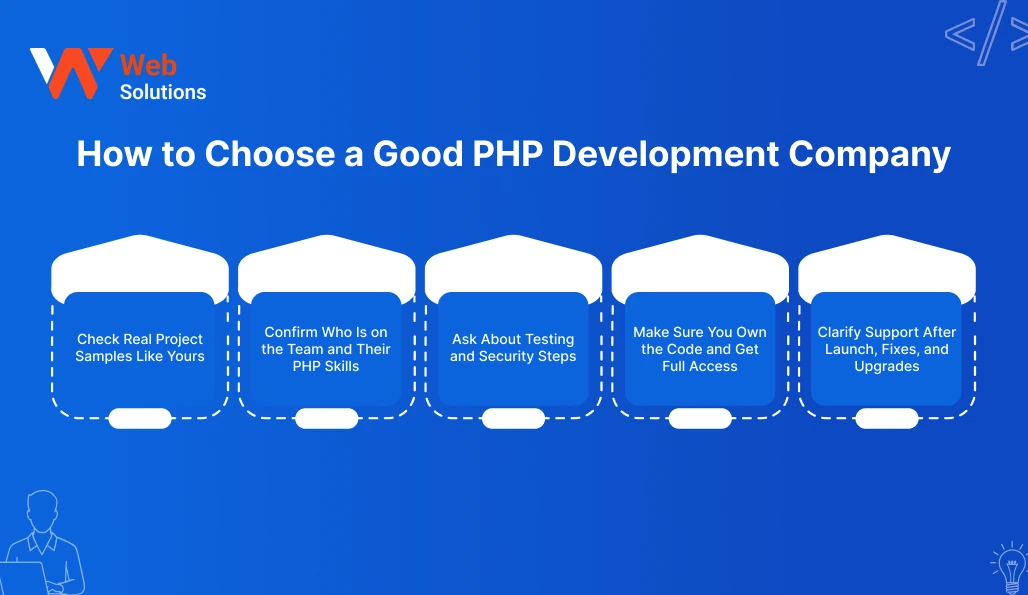
A strong partner saves money in the long run. Not because the first quote is low, but because the build stays stable after launch. Many teams can “deliver a site.” Fewer teams can deliver clean code, clear documentation, and a support plan that prevents panic later. For PHP web development, the right company should explain trade-offs in plain words and set honest scope limits. It should also show real proof, not only promises. Use the checks below before signing anything.
-
Check Real Project Samples Like Yours
Real samples show real capability. Look for projects similar in flow, like portals, dashboards, ecommerce, or booking systems, not just brochure websites. Ask what problems were solved and what scale was handled. Also check if the work looks stable after launch, meaning updates, performance, and security were managed well. A good company will share what went wrong too, and how it was fixed.
-
Confirm Who Is on the Team and Their PHP Skills
A proposal means nothing if the team changes later. Ask who will actually code, review, and test the project. Check how many years the developers have worked in PHP, and which frameworks they use most. Also confirm who handles architecture decisions and who owns security decisions. Strong delivery needs more than one developer, it needs a clear lead.
-
Ask About Testing and Security Steps
Testing and security should be part of the process, not an afterthought. Ask how bugs are caught before launch and how regression testing is handled after updates. Also ask how dependencies are checked and how common risks like injection, broken auth, and access issues are prevented. A reliable partner will describe these steps clearly and include them in the timeline.
-
Make Sure You Own the Code and Get Full Access
Ownership avoids lock-in. Confirm that the full codebase is shared, not partial files. Get access to repos, hosting, staging, and production environments. Also confirm documentation handover, credentials policy, and how secrets are stored. For long projects, access matters as much as features, because future upgrades depend on it.
-
Clarify Support After Launch, Fixes, and Upgrades
Most issues show up after users start using the site. Ask what support looks like, response times, working hours, escalation path, and what is included vs billed separately. Also confirm how upgrades are handled for PHP versions, server changes, and framework updates. The right support plan keeps the site stable and reduces downtime surprises.
The Future of Web Development Using PHP

The future of PHP looks steady, not noisy. Businesses still need reliable portals, content sites, and systems that run daily operations. In 2026 and beyond, the real push is not “new syntax.” It has better uptime, safer code, faster pages, and smoother updates. PHP web development will keep moving toward API-first work, modular architecture, and stronger operational discipline. Teams that treat performance, security, and testing as routine will win. That is also what separates average vendors from a strong PHP Development Company delivering long-term PHP development services.
1. PHP Will Stay Strong for Business Websites and Portals
PHP fits business work like logins, dashboards, forms, and role-based access. These are not experimental features, they are daily needs. Many companies also prefer stable tech with easy hiring and predictable hosting. That is why PHP web development services will keep being used for portals, internal tools, and customer accounts. The focus will be on clean builds that stay easy to upgrade.
2. More API Work and Headless Builds Will Grow
More websites are becoming “multi-channel.” The same backend may serve a website, a mobile app, and partner tools. That drives API-first builds and headless setups, where content and data are served through endpoints. This makes PHP web services more important than page-only logic. It also helps teams change the frontend later without rewriting the backend.
3. Security and Performance Will Matter More Than New Features
Users are impatient and threats are real. So speed and safety will outweigh flashy features. Businesses will expect secure auth, strict access control, audit logs, and safe dependency management. Performance will focus on caching, database tuning, and stable deployments. Many PHP web development solutions will be judged by reliability, not by how many features were packed in.
4. Frameworks Will Keep Getting Cleaner and More Modular
Frameworks are moving toward smaller, reusable components and clearer structure. This helps teams upgrade parts of a system without breaking everything. It also reduces “framework lock” anxiety because components can be swapped more easily. For a PHP Development Company, this means better maintainability and smoother handovers across teams. Cleaner modular frameworks also reduce long-term support cost.
5. Developers Will Need Better Testing and DevOps Habits
The biggest shift is discipline. Teams will need automated tests, staging environments, monitoring, and repeatable deployments. Without this, every update becomes risky. Better DevOps habits also reduce downtime and speed up fixes when issues appear. Strong PHP development services will include these practices by default, because businesses want stability after launch, not just a delivery date.
Also, read: Is Web Solutions Consulting Worth It for Small Businesses?
Conclusion
PHP is still a practical choice in 2026. It powers serious business work, from portals and dashboards to eCommerce web solutions and content sites. The language is not the problem. The difference comes from how it is built, how it is tested, and how it is maintained after launch. When code is clean and upgrades are planned, sites stay fast and stable for years.
The safe way forward is simple. Use modern versions, pick a framework that matches the project, and make testing a habit. Keep security and performance as routine steps, not last-minute fixes. Treat support as part of the build, because real issues show up only when users arrive.
If the goal is a site that stays stable and easy to improve, PHP web development remains a solid bet.
FAQs
1. Is PHP Web Development Still Worth Learning in 2026?
Yes. PHP web development is still worth learning because many real business sites run on it. The skills are useful for portals, dashboards, content sites, and ecommerce. The key is to learn modern PHP, clean code habits, and one framework properly. Avoid old shortcuts, and focus on security and performance basics.
2. When Should You Hire a PHP Development Company Instead of Building In-House?
Hire a PHP Development Company when speed and reliability matter more than building a team from scratch. It also makes sense when the project needs stronger security, complex integrations, or strict timelines. If hiring, onboarding, and managing developers will slow the business down, external help reduces risk. In-house works best when the team will keep building full-time.
3. What Are the Must-Have PHP Web Services for a Modern Website?
Must-have PHP web services usually include secure login, role-based access, clean APIs, form handling, and admin controls. Payment and refund handling matters for ecommerce. Notifications, logs, and monitoring help keep the site stable. Backups and upgrade support are also critical, because a modern website is never “done” after launch.
4. What Is Included in PHP Development Services for a Business Website?
PHP development services typically include planning, UI screens, backend development, database setup, and key integrations. QA testing, deployment setup, and documentation are also part of a clean scope. Good teams also include security basics, performance checks, and a post-launch support window for fixes. The final scope depends on pages, roles, and integrations.
5. What Do Strong PHP Web Development Services Look Like From Planning to Launch?
Strong PHP web development services start with clear scope and a realistic MVP plan. Then comes design, backend build, and integration work with code reviews. Testing covers real devices, browsers, and failure cases like payment errors. Launch includes staging checks, backups, monitoring, and a rollback plan. After launch, fixes, updates, and performance tuning keep the site steady.