
Web Solutions Consultant Role in Digital Transformation
Digital transformation is changing the entire process of businesses, customer connections, and value delivery. It has transcended merely being about new technology adoption and has emerged as the path of organizations that are smarter, more flexible, and customer-oriented. Still, plenty of businesses fail to address and even see the complicated transition that requires a precise plan and skilled technical support.
At this point, the services of Web Solutions Consulting come into play as necessary. The consultant for professional web solutions is like a strategic partner who ensures that business objectives and digital technologies are in the same direction. Automation and cloud infrastructure implementation, customer experience optimization, and website performance are among the areas where these specialists will help the organization transition with certainty.
In this era of continuous innovation, a reliable web solutions partner will secure not only the success of your digital transformation but also its sustainability. So, in this blog we will ke knowing about The Role of a Web Solutions Consultant in Digital Transformation,
What Is Web Solutions Consulting?
Web Solutions Consulting is the term used for the process of giving advice and backing up companies in using web-based systems and technologies that lead to their performance and growth. This is a consultative and not a developer’s service approach that includes strategic planning, technical proficiency, and a broad knowledge of digital ecosystems all at once.
The consultant not only does coding or design but also understands the business’s objectives, assesses its digital readiness, and maps out web technology alongside business growth. By this method, every single investment made in website development solutions will be a contribution to the long-term sustainability and customer satisfaction of the company.
Key Benefits of Web Solutions Consulting
- It helps to connect the company goals with the appropriate digital tools and technologies.
- User experience and engagement are improved across the web and mobile platforms.
- Operational efficiency is increased by automating processes.
- Digitally built systems are guaranteed to be scalable and ready for the future.
- It cuts costs by avoiding technology misalignment or redundancy.
Partnering with an experienced web solutions company ensures you’re not just building digital assets; you’re building a smarter, more connected business ecosystem.
The Role of a Web Solutions Consultant in Digital Transformation
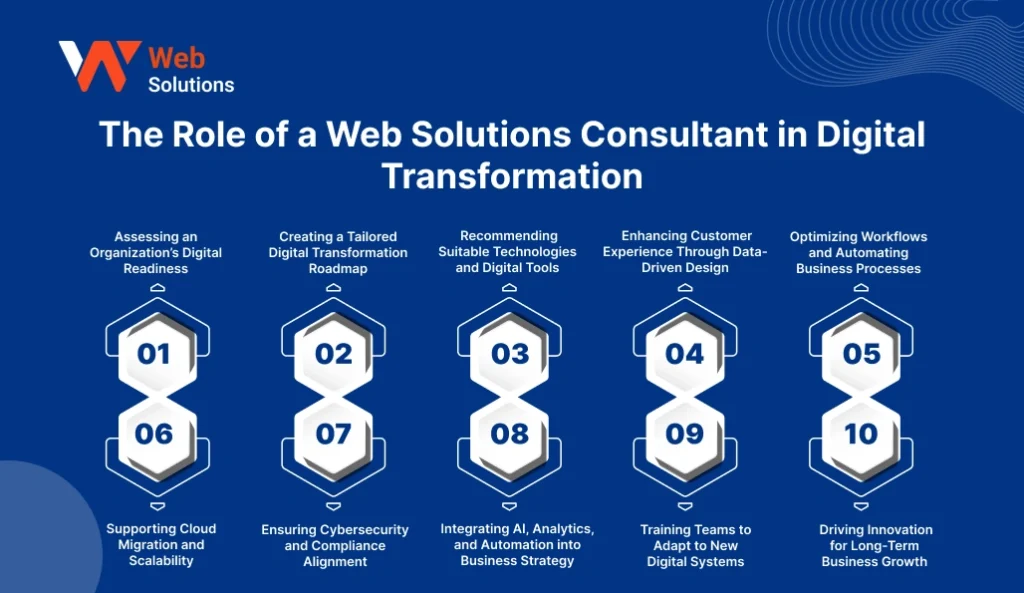
A Web Solutions Consultant is not just a technical expert but a strategic advisor who enables organizations to evolve. Their role spans from assessing business readiness to driving innovation. Below are the ten crucial roles they play in guiding digital transformation, each explained in detail with actionable key points.
1. Assessing an Organization’s Digital Readiness
At the very beginning of the transformation process, consultants assess the readiness of the organization to take up the change. They carry out an analysis of the existing infrastructure, the skills of the employees, the interactions with the customers, and the digital workflows. The results of this assessment not only illustrate the shortcomings and the possibilities but also help in defining a very practical transformation strategy.
- Performs a thorough digital maturity audit.
- Detects technological deficiencies and integration problems.
- Assesses the productivity of existing tools and systems.
- Studies customer data and engagement patterns.
- Gives clues for strategic decision-making.
2. Creating a Tailored Digital Transformation Roadmap
Every organization has its own unique transformation journey. An expert from Web Solutions Consulting creates a custom roadmap including technology adoption, process re-engineering, and performance milestones. This roadmap lets digital transformation fit with the company’s vision, budget, and operation structure.
- Defines short-term and long-term transformation goals.
- Outlines key deliverables, budgets, and timelines.
- Prioritizes projects based on business impact.
- Identifies KPIs to track progress and ROI.
- Ensures executive alignment and stakeholder buy-in.
3. Recommending Suitable Technologies and Digital Tools
The quick growth of technology makes the selection of an appropriate stack very important. The consultants evaluate the technical environment of the company and suggest the solutions that will provide the best performance and scalability. The consultants’ recommendations, no matter if they are about the CMS, CRM, or cloud solution, eliminate expensive errors and make sure that the systems work together.
- Evaluates current tech infrastructure and gaps.
- Suggests platforms aligned with business size and needs.
- Ensures compatibility with existing systems.
- Focuses on scalability and integration capabilities.
- Helps businesses future-proof their technology choices.
4. Enhancing Customer Experience Through Data-Driven Design
A consultant makes sure that your digital transformation is all about customer satisfaction and they apply analytics and UX methods to develop smooth, fast, and individualized interactions on different platforms. This customer-centric model increases not only retention but also brand loyalty and sales.
- Conducts UX research and user journey mapping.
- Implements responsive, mobile-first designs.
- Uses data analytics to enhance personalization.
- Optimizes site speed and usability.
- Aligns user experience with business objectives.
5. Optimizing Workflows and Automating Business Processes
Digital transformation is fundamentally grounded in automation. The consultants spot the manual, repetitive processes suitable for automation and thus set aside the time for the more strategic activities. This leads to a scenario where productivity goes up, operational costs come down, and inter-team collaboration gets improved.
- Maps current workflows and identifies inefficiencies.
- Introduces automation tools for repetitive tasks.
- Enhances communication between departments.
- Reduces human errors and processing delays.
- Increases overall operational agility.
6. Supporting Cloud Migration and Scalability
The cloud technology becomes a necessity as business growth issues arise. A web solutions company supports the transfer of the old systems to the cloud, guaranteeing the benefits of flexibility, instantaneous access, and cheaper operation costs. The same company gives advice about plans that make cloud access secure and people-friendly without interrupting the usual flow of work.
- Analyzes existing IT systems for cloud readiness.
- Selects the right cloud service provider.
- Plans phased migration with minimal downtime.
- Implements data backup and recovery measures.
- Ensures compliance with cloud security standards.
7. Ensuring Cybersecurity and Compliance Alignment
Data security is still an issue of the utmost importance in every digital venture. Cybersecurity standards become part of the web consultants’ daily work, and they always operate under international data laws like GDPR and HIPAA. To create a digital ecosystem that is secure, regulation-compliant, and trustworthy is the final aim.
- Conducts security risk assessments.
- Implements firewalls and data encryption.
- Ensures compliance with industry standards.
- Monitors and updates security protocols.
- Educates teams on cybersecurity best practices.
8. Integrating AI, Analytics, and Automation into Business Strategy
Not only building websites is what Modern Web Solutions Services provides, but also AI-powered analytics and automation. By harnessing these technologies, consultants facilitate decision-making, predict customer behavior, and enhance marketing actions, thus making businesses smarter and faster to respond.
- Implements AI tools for predictive analysis.
- Integrates business intelligence dashboards.
- Automates routine decision-making processes.
- Personalizes customer engagement using data insights.
- Tracks and improves business performance through analytics.
9. Training Teams to Adapt to New Digital Systems
The digital transformation yields successful results only when personnel accept the change. The consultants conduct practical training workshops with the aim of making the employees familiar and comfortable with novel tools and new ways of working. In this way, the organization is more efficient, and, at the same time, there is less resistance to the technology changes.
- Conducts practical training workshops.
- Creates easy-to-follow documentation.
- Provides continuous technical support.
- Promotes a digital-first workplace culture.
- Measures adoption and performance improvement.
10. Driving Innovation for Long-Term Business Growth
A real web solutions consultant is not only the one that implements solutions but also the one that inspires innovation. They keep on checking trends, bringing in new technologies, and supporting experiments that allow the companies to make it to the top of the list in the market that is constantly changing.
- Tracks emerging digital and tech trends.
- Encourages data-driven innovation.
- Advises on new market opportunities.
- Recommends scalable growth solutions.
- Ensures sustainable digital evolution.
Key Responsibilities of a Web Solutions Consultant
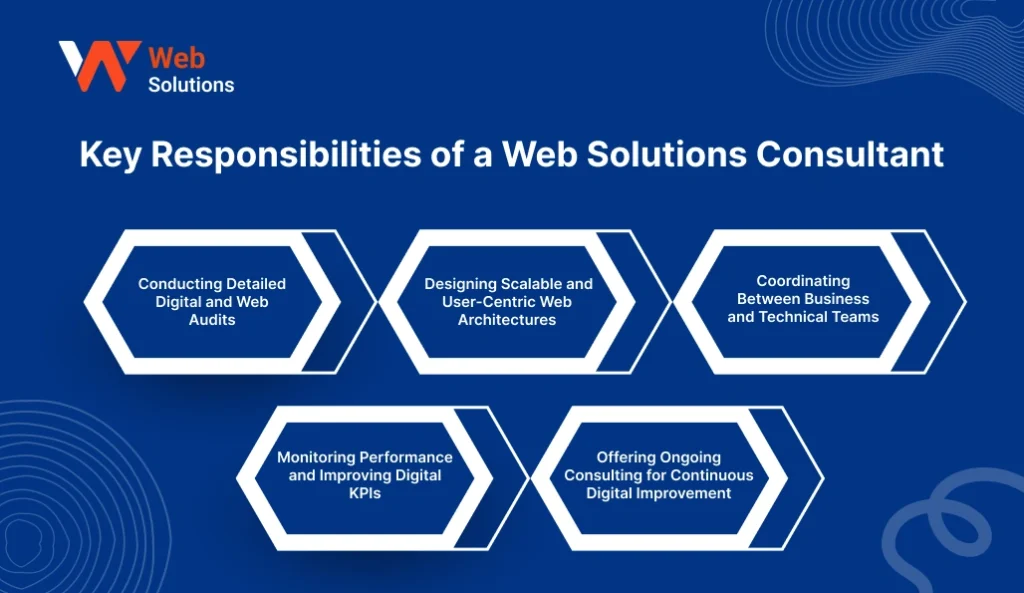
Beyond their strategic roles, consultants have a set of hands-on responsibilities that keep transformation projects successful. Each task ensures consistent performance, measurable growth, and continued digital optimization.
1. Conducting Detailed Digital and Web Audits
A web consultant starts by evaluating the company’s digital resources, such as websites, applications, and backend systems. They analyze the performance metrics, SEO health, content quality, and infrastructure efficiency as well. This examination reveals the present strengths and weaknesses from a 360° perspective.
- Reviews website performance and loading times.
- Evaluates SEO structure and ranking factors.
- Assesses mobile responsiveness and UX design.
- Checks for security vulnerabilities and code quality.
- Recommends data-backed improvement strategies.
2. Designing Scalable and User-Centric Web Architectures
Scalability guarantees that your systems will evolve along with your business. The consultants create structures that are modular, effective, and able to manage traffic surges or the addition of new features without any interruption. Performance and usability are integrated into their designs for the purpose of getting the most out of the digital impact.
- Develops modular and flexible architecture models.
- Ensures high availability and minimal downtime.
- Designs with future scalability in mind.
- Aligns architecture with UX best practices.
- Facilitates seamless integration with third-party tools.
3. Coordinating Between Business and Technical Teams
The communication is one of the main pillars of Web Solutions Consulting. The consultants are acting as the intermediaries and ensuring that the developers and the managers from the business side comprehend each other properly. This unification eliminates the possibility of technical mistakes and paves the way for the project to run smoothly.
- Translates business goals into technical requirements.
- Facilitates collaboration between teams.
- Conducts regular progress meetings and reviews.
- Ensures deadlines and quality standards are met.
- Resolves conflicts through transparent communication.
4. Monitoring Performance and Improving Digital KPIs
The transformation does not stop at implementation. The consultants do not just track the basic KPIs but also monitor critical ones like engagement and conversion rates, operational efficiency, etc. They make use of analytics tools in order to find out what is actually working and where the tuning is required.
- Defines KPIs aligned with business objectives.
- Uses analytics dashboards for performance tracking.
- Conducts A/B testing for optimization.
- Provides monthly and quarterly progress reports.
- Adjusts strategies based on real-time data.
5. Offering Ongoing Consulting for Continuous Digital Improvement
Digital transformation is an ongoing process, not a single-time project. Consultants give long-term strategic support so as to adjust systems to new technologies, user behaviors, and market changes. This guarantees that your company stays competitive and technologically advanced.
- Conducts regular system health checks.
- Introduces emerging technologies periodically.
- Updates digital strategies based on new trends.
- Offers performance optimization and scaling support.
- Builds a roadmap for long-term digital sustainability.
Conclusion
The role of the Web Solutions Consultant is to ensure the mapping of technology with the business goals, thus the measurable results delivered. Their expertise covers all stages from conducting audits and designing scalable architectures to implementing automation and AI, meaning businesses can be agile, secure and customer-friendly. If you want your organization to be able to adapt to the changing environment, it would be best for you to tie up with a reputed web solutions company that offers professional web solutions services.
Digital transformation is not just a matter of technology adoption; It is a case of restructuring the business to be future-ready. And with the right consulting partner for online solutions, the future will be bright, connected and full of possibilities.
FAQs
1. What does a Web Solutions Consultant do?
The role of a web solutions consultant involves analyzing a company’s digital environment, proposing appropriate technologies and applying methods to improve all factors: performance, scalability and customer experience.
2. How does Web Solutions Consulting support digital transformation?
This service not only factors technology investments into business goals but also, over time, makes human resources more productive and handles data more efficiently, and finally, the latter ensures that modern digital tools work together quietly.
3. Which industries benefit most from Web Solutions Consulting?
The same way eCommerce, healthcare, fintech, education, and logistics industries do, because they extensively depend on digital systems and the information provided by customers to make a decision.
4. What makes a good Web Solutions Consulting partner?
Look for these in a consulting partner: experience, technical skills, ability to communicate effectively, and maintaining a strong portfolio of website development solutions.
5. Why choose a professional web solutions company?
A professional web solutions company guarantees a smoother execution and a better return on investment from digital transformation initiatives by providing a skilled team, a tested process, and the newest technology as its assets.