Top 10 Benefits of Choosing Magento Web Development Services for Creating a Scalable Online Store

Traffic spikes do not warn you before they hit. One day, the store feels fine. Next day, a sale email goes out, and checkout starts lagging. That is when “scalable” stops being a nice word and becomes a real business need.
In that moment, you do not need new ideas. You need the store to hold up. Pages should load quickly, the rules for the cart should work, and payments should not fail halfway through. Customers will leave if the site is slow, and they might not come back. This is why scalable ecommerce is all about keeping the basics strong, even when you’re busy.
According to Shopify’s global ecommerce report, sales will reach $6.88 trillion in 2026, and ecommerce may make up 21.1% of all retail sales that year. The U.S. International Trade Administration says that the global B2B ecommerce market will be worth $36 trillion by 2026. This means that more people will order things online, and they will still expect your store to load quickly on their phones.
Many brands pick Magento web development services because they need tighter control. Things like a big catalog, tricky checkout rules, multi-store selling, and tool integrations often need more than a basic setup. Magento sits under Adobe Commerce now, and Adobe presents it as a platform made for larger, more complex stores and API-based builds.
This guide covers what matters in real projects. The key benefits, the build steps, typical cost ranges, 2026 trends, common problems, and how to choose the right development partner.
TL;DR
- If you want to grow your business and have full control over products, prices, and checkout, Magento is a great choice.
- Even during peak sales hours, Magento web development services are a big help with keeping pages loading quickly, making sure payments go through smoothly, and keeping security updates on time.
- The budget tends to go up if you decide to add integrations, multiple store setups, migrations, or a personalized checkout flow.
- More and more stores in 2026 are switching to headless builds, PWAs, API, first setups, and more intelligent on-site personalization.
- The right Magento web development company can make or break a project, even if the platform is good.
Key Points
- Magento web development is not only theme work, but it also includes hosting setup, modules, speed tuning, security, and testing.
- Magento performs best when the build stays clean and planned. Quick patches may work for a week, then they start breaking other parts of the store.
- You can sell more with multi-store, multi-currency, and third-party tools. But they also add more rules and moving parts, so you need to plan ahead for them.
- Performance work should start early because slow category pages and checkout delays directly hurt conversions.
- Only when updates are made on time, admin access is limited, and extensions are checked before they go live does security stay strong.
- When you pick a Magento web development company, look beyond the sales talk. Check real Magento work, relevant certifications, and what support looks like after launch.
What is Magento Web Development?
Magento web development refers to the processes involved in building and operating an online store on Adobe Commerce, which is also called Magento. The initial development basically entails things you see in the store, like theme, product pages, cart, checkout, and payments. However, it also includes fairly technical tasks such as enhancing speed, securing the store, setting up servers, and linking the store with tools like ERP, CRM, shipping, and tax systems. The overall objective is to have a reliable store that is fast and easy to manage, even when the number of orders increases.
Brands opting for Magento web development services are usually those whose requirements quickly outgrow a basic plug-and-play kind of platform. Magento is a platform that can manage huge product catalogs, several storefronts, and complicated price rules. It also lets you add custom modules, which means you can add new features without messing up the main setup. So, a well-designed Magento platform can be a great base for real business growth, not just a pretty store.
Benefits of Choosing Magento Web Development Services for E-commerce
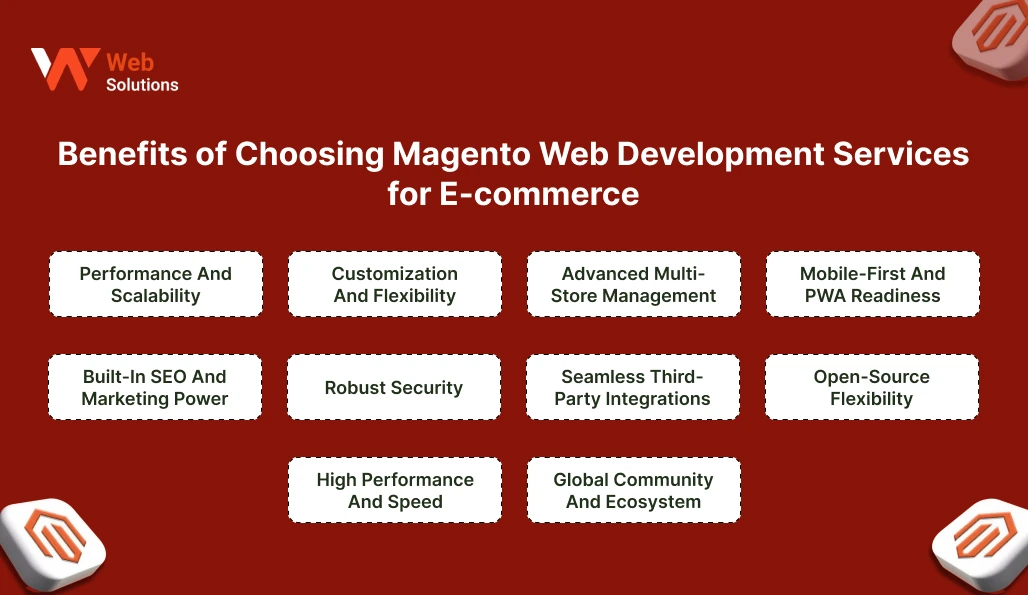
A store can feel perfect at 20 orders a day. Then a sale hits, traffic shoots up, inventory changes fast, and someone asks for a quick checkout tweak. That is when Magento shows its value. It works well for e-commerce brands that need more control over the catalog, checkout, pricing rules, and integrations. The store can grow without getting slow or shaky if it is set up correctly.
When you choose Magento web development services, you are paying for more than pages and design. You are paying for a clean build, safer custom work, and a store that stays steady during busy peaks. The benefits below are the ones you feel in daily operations, not just in a demo.
1. Performance And Scalability
Magento can handle large catalogs and a lot of traffic, but only if the installation is done right. The developers need to make caching work better, get rid of slow database calls, and pick the right server so that pages don’t get stuck during sales. Customers will even quit after a 2-3 seconds delay on a big sale day.
2. Customization And Flexibility
Every store has small rules that make it unique. Like tier pricing, bundles, custom shipping logic, or special checkout steps. Magento supports deeper custom flows than most plug-and-play platforms. A solid build keeps custom code clean, so updates do not break the store. You get flexibility, without turning the site into a patchwork.
3. Advanced Multi-Store Management
Multi-store is a major time saver if you are dealing with a few brands or selling to different regions. With Magento, you can run more than one store from the same backend. Stores can have their own rules for pricing, themes, catalogs, and currencies. It may seem hard to set up at first, but once everything is in place and checked, it’s a great way to grow. It helps teams scale across locations without running separate systems.
4. Mobile-First And PWA Readiness
Most e-commerce traffic is mobile now, and people have low patience. Magento supports mobile-first builds and can work well with PWA setups for faster browsing. A PWA-style store can feel more like an app, with smoother loading and better repeat visits. This is useful when your buyers shop on weaker networks or older phones.
5. Built-In SEO And Marketing Power
Magento gives you a lot of control over important SEO things like URLs, metadata, sitemaps, and canonical tags. It can also be set up to support rich snippets, fixes for layered navigation, and better category structures. From the marketing perspective, you have the possibility to run various kinds of promotions, such as coupon rules, cart price rules, or segmented offers. Hence, it becomes straightforward to determine, through experimentation, what will eventually lead to customers coming back for more.
6. Robust Security
E-commerce sites handle payments, accounts, and personal information. You can’t think about security later. Magento has a strong security framework, but it still needs to be patched correctly, have access controls set up, and have its servers hardened. A good setup has clear roles for admin users, APIs that are safe, and updates that happen on a regular basis. This makes it less likely that the store will go down or that data will leak.
7. Seamless Third-Party Integrations
Most stores use more than one tool to run. Payments, shipping, inventory, customer service, email, analytics, and accounting. Magento lets you connect your store to tools you already use through APIs and extensions. The key is doing it carefully, because rushed integrations can slow down the site. Work that is clean and well-integrated keeps your orders moving.
8. Open-Source Flexibility
Magento has an open-source edition, which gives teams room to customize the store without being boxed in. You can extend features, adjust workflows, and control hosting choices. This is useful if you want to avoid being locked into one vendor’s limits. But open-source also means you must manage quality, updates, and security with care.
9. High Performance And Speed
Speed is not only about hosting. It is also about frontend code, image handling, caching, and database health. Magento can be fast, but it needs performance work from day one. A strong build focuses on Core Web Vitals, clean theme code, and fewer heavy scripts. Faster pages usually mean better SEO and better conversion, both.
10. Global Community And Ecosystem
Magento has a large global ecosystem. That means more extensions, more dev talent, and more fixes already solved by others. It also means regular patches and a strong knowledge base for common problems. If you choose wisely, you are not building alone. You are using a platform that has been tested by many e-commerce teams across industries.
The Magento Web Development Process
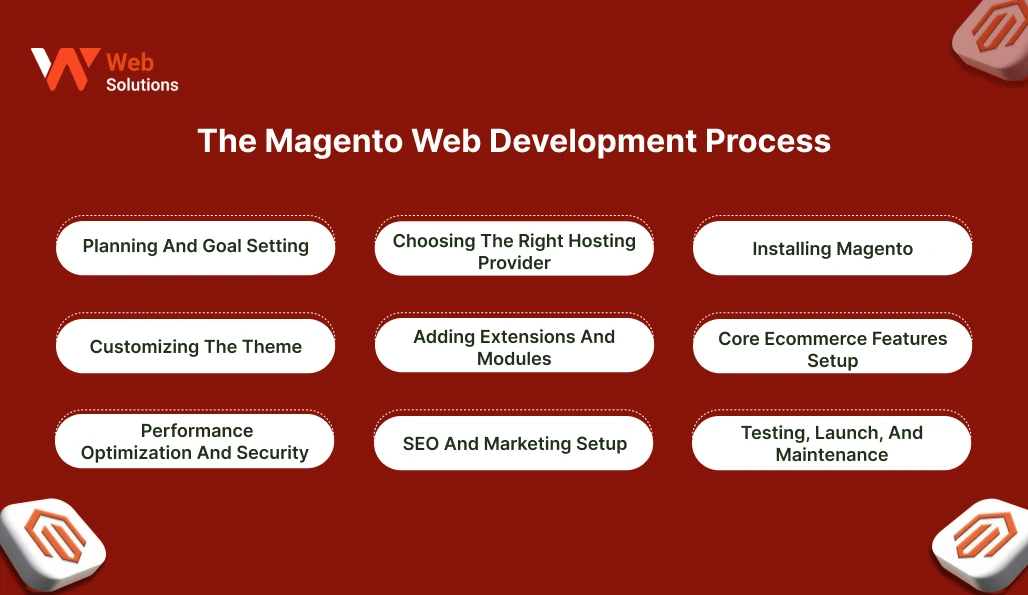
Magento projects go smoothly when the process is clear. Not rushed. Not “build first, fix later.” A good Magento web development company starts by locking goals, then builds in steps, and tests on real devices before launch. This is how Magento web development solutions stay stable when traffic grows, and more tools get added.
Step 1: Planning And Goal Setting
Start with clarity. What are you selling, who is buying, and what is “success” in the first 60 days? List must-have features like shipping rules, taxes, payment methods, and product types. Also decide what can wait for phase two. In Magento web development, planning saves time because it reduces rework and avoids last-minute scope creep.
Step 2: Choosing The Right Hosting Provider
Hosting affects how fast Magento runs, how often it goes down, and how well it handles spikes. The server should have the right version of PHP, database setup, caching, and CDN options. Managed cloud hosting is common for busy stores, but the choice depends on traffic and budget. The goal is simple. Keep checkout stable even during peak hours.
Step 3: Installing Magento
Next comes clean installation and environment setup. Dev, staging, and production should be separate, so changes are tested safely. The team sets file permissions, config files, and basic store settings. A proper install also includes version control and a rollback plan, because updates can go wrong.
Step 4: Customizing The Theme
Theme work is not only about looks. It impacts speed and mobile usability. The best teams use lightweight code, optimise images, and avoid heavy scripts. They also match the theme to brand style, product browsing needs, and checkout simplicity. This is where your store starts feeling “yours.”
Step 5: Adding Extensions And Modules
Extensions quickly add new features like reviews, shipping tools, analytics, or payment options. But having too many extensions can make the store run slowly or cause problems. A good team reviews each module for code quality, update history, and security. This step is where many stores get messy, so picking carefully matters.
Step 6: Core Ecommerce Features Setup
Now the store gets its working backbone. Product types, categories, attributes, pricing rules, taxes, shipping zones, and payment gateways. Admin roles and permissions are also set here, so staff access stays controlled. If you sell across regions, this is the step where currency and language settings are planned properly.
Step 7: Performance Optimization And Security
This step keeps the store fast and safe. Caching, indexing, database tuning, and page speed fixes happen here. Security work includes patching, admin URL protection, 2FA where needed, safe file permissions, and secure API usage. Strong Magento web development services treat speed and security as daily work, not a one-time checklist.
Step 8: SEO And Marketing Setup
Magento has support for SEO basics, however, the setup is crucial. The Site Integration Team needs to review clean URL structure, metadata patterns, XML sitemaps, robots rules, canonical tags, and schema support. On the marketing side, teams configure coupon rules, cart price rules, email flows, and tracking for conversions. This is where the store gets ready to attract traffic and convert it into sales.
Step 9: Testing, Launch, And Maintenance
Before launch, test like a real customer. Signup, OTP emails, cart, checkout, payment success and failure, refund flow, and mobile load time. Test on older phones and slower networks too. After launch, maintenance starts. Updates, security patches, bug fixes, and small improvements keep the store stable as orders grow. This is why long-term support is a key part of most Magento web development solutions.
Why Businesses Need Magento Web Development Services
A Magento store is not “install and sell.” It is more like setting up a full retail outlet with stock rooms, billing counters, security, and staff access. The whole experience is bad if one part is weak. That’s why a lot of growing brands hire Magento web developers instead of trying to fix things themselves.
Magento is strong, but it has many layers. All of the themes, modules, server settings, caching, database work, and security updates are in one place. A small mistake, like a heavy extension or poor hosting, can slow down category pages and hurt checkout. Even basic changes like adding a new payment method or fixing a shipping rule can break things if the build is not clean.
Businesses also need Magento support because ecommerce never stays still. New products, seasonal offers, price updates, and third-party tool changes happen all the time. A steady Magento web development company keeps the store updated, fixes issues early, and plans upgrades safely, so the site does not turn into a fragile mess after six months.
Most importantly, Magento helps when scale is the goal. Larger catalogs, multi-store setups, multi-currency selling, and deeper integrations need proper planning and testing. With the right Magento web development solutions, the store stays fast, secure, and ready for growth, not just ready for launch.
Suggested Article: PHP Website Development Cost: A Complete Pricing Guide for 2026
Cost Of Magento Web Development Services
Most small to medium-sized ecommerce builds that use Magento cost between $30,000 and $150,000, depending on the features and integrations. Magento costs can look simple at first. Then you add one more store view, one ERP sync, or a custom checkout rule, and the budget moves. That happens because Magento work is not only about design. It includes hosting setup, theme build, module checks, speed tuning, security patching, and testing across devices.
Most teams choose a Magento build when they want a store that can grow without breaking. The final cost depends on 4 things. Store size, custom features, integrations, and how clean the data is for migration.
| Project Type | Timeline | Estimated Cost (USD) |
| Basic Magento Store Setup | 4–8 weeks | $8,000–$25,000 |
| Custom Theme + UX Build | 6–12 weeks | $20,000–$60,000 |
| Mid-Size Ecommerce With Integrations | 10–16 weeks | $45,000–$120,000 |
| Multi-Store Or Multi-Region Setup | 12–20 weeks | $80,000–$200,000 |
| Magento 1 To Magento 2 Migration | 8–16 weeks | $30,000–$150,000 |
| Enterprise Magento Build | 16–28+ weeks | $150,000–$400,000+ |
| Ongoing Support And Maintenance | Monthly | $1,000–$8,000+ / month |
Future Trends In Magento Web Development Trends In 2026
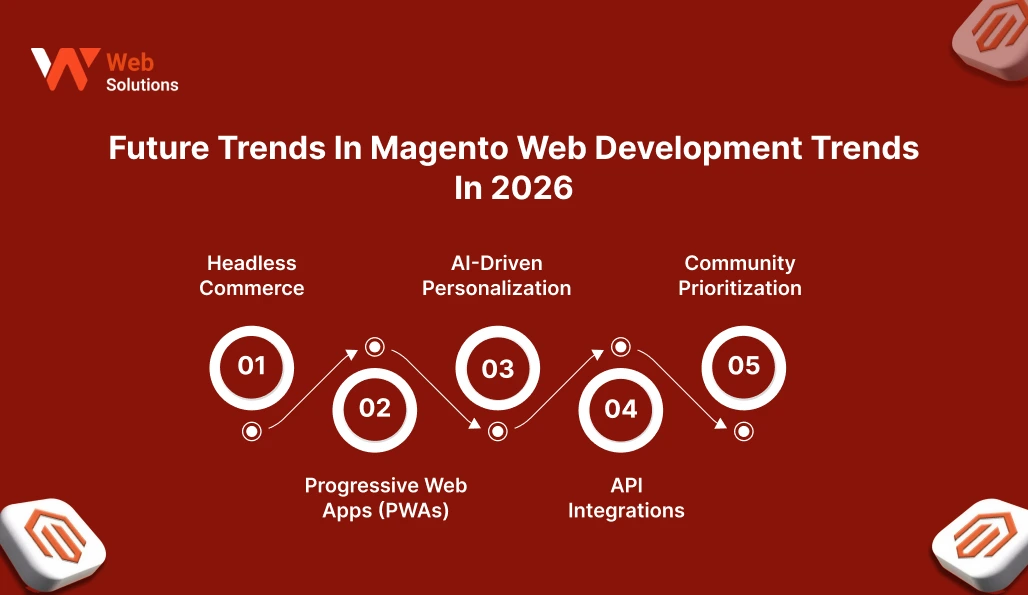
By 2026, Magento web development is becoming increasingly modular and more focused on speed. Retailers are gradually abandoning large, all, in, one, heavy constructions. Developers want components that can be radically changed, for instance, the storefront, the search and the checkout, without putting the entire system at risk. Hence, a lot of brands choose the Magento web development services of a team that can not only deliver on time but also plan for upgrades and the long-term growth of the business.
01. Headless Commerce
Headless is growing because it makes storefronts faster and easier to change. The Magento backend still runs products, pricing, orders, and admin work. But the frontend is built separately with modern frameworks. A good Magento web development company uses this setup when a brand wants to give its customers a unique experience, make pages load faster, and have more control over the UI.
02. Progressive Web Apps (PWAs)
PWAs are still very popular because they make users feel like they are using an app on their phones, even though they really open in a browser. They typically load faster, give better performance on slow networks, and help browsing to be smoother. A lot of Magento web development companies are nowadays incorporating the idea of PWA right from the start as that is the mobile side where majority of the drop-offs occur. So, a well-made PWA not only makes the site load faster, but it also gets more people to come back.
03. AI-Driven Personalization
Personalization is becoming more practical and less “manual work.” Stores want smarter product suggestions, better search results, and more relevant category sorting. AI is helping with this, but only if the data is clean and the tracking is set up correctly. This trend works best in real projects when you start small, test, and then grow. Not when you try to personalize everything on day one.
04. API Integrations
Integrations are getting deeper in 2026. Not only payments and shipping. Also, ERP, OMS, CRM, loyalty, and support tools. API-first builds keep these connections cleaner, so the store does not slow down later. This is where experienced Magento web development services matter, because rushed integrations are a common reason for checkout issues and reporting gaps.
05. Community Prioritization
The Magento ecosystem still saves time. Extensions, developer forums, and proven patterns help teams move faster. But the new mindset is “use fewer, use better.” Having too many extensions can cause problems and make upgrades hard. A good Magento web development company will pick stable modules, test them well, and keep the codebase clean so that updates are easy to handle.
Common Challenges In Magento Web Development
In fact, Magento allows one to have profound dominion over the platform; however, if someone is an impatient and careless worker, it can also be a source of punishment for them. Most of the time, the problems won’t be with the platform itself. Instead, a messy setup, too many extensions, weak hosting, or not enough testing are to blame. This is why a lot of teams hire Magento web development services instead of trying to build it themselves, especially if they think the store will grow. Essentially, a trustworthy Magento web development company foresees such regular issues and plans for them in advance so that you don’t witness them after the launch when the sales are already flowing.
1. Migrating From Magento 1 To Magento 2
Migration is not a simple “copy and paste.” Data, themes, extensions, and custom code need mapping. Product details, customer accounts, order history, and URL redirects must all move smoothly, or SEO and customer logins will stop working. During migration, many brands also find problems with old data, such as duplicate SKUs or missing images. Strong Magento web development solutions include a staging migration first, then a final cutover with a rollback plan.
2. Complexity Of Multi-Store
Multi-store looks easy on paper. One backend, many storefronts. In reality, it needs clean planning for catalog rules, pricing, inventory, tax, and permissions. One wrong setting can change product visibility across stores. Teams also struggle with content updates because each store needs its own banners, pages, and SEO setup. In Magento web development, multi-store works best when naming rules, roles, and workflows are decided early.
3. Multi-Currency Environments
Multi-currency is more than showing a currency symbol. You need correct exchange rules, rounding, tax handling, and price display across product pages, cart, and checkout. Payment gateways and refund handling must also match the currency logic, or finance teams get confused fast. If you sell across regions, currency and shipping rules must be tested together. A skilled team treats this as a full journey test, not a setting toggle.
4. Security Concerns
E-commerce is a target, and Magento stores are no exception. Admin access, outdated extensions, weak server rules, and delayed patching can create risk. Role-based access, protected APIs, and safe backups are also part of security. Good Magento web development services keep patching and monitoring part of ongoing work, not a one-time task done at launch.
5. Performance Bottlenecks
When catalogs get bigger or caching and indexing aren’t done right, Magento can slow down. Heavy themes, unoptimised images, slow database queries, and too many scripts can hurt speed. The checkout flow is the biggest problem because even small delays can hurt sales. A good Magento web development company will work on caching, CDN, database tuning, and clean frontend code early on, not as a last-minute fix.
6. Extension Conflicts
Extensions save time, but they can also break the store. Conflicts happen when two modules touch the same checkout step, pricing rule, or admin function. Some extensions also slow the site or stop working after updates. The safest approach is to use fewer, well-supported modules and test each change on staging first. Most stable Magento web development solutions follow this rule, even when the store owner wants “just one more plugin.”
How To Choose The Right Magento Web Development Company
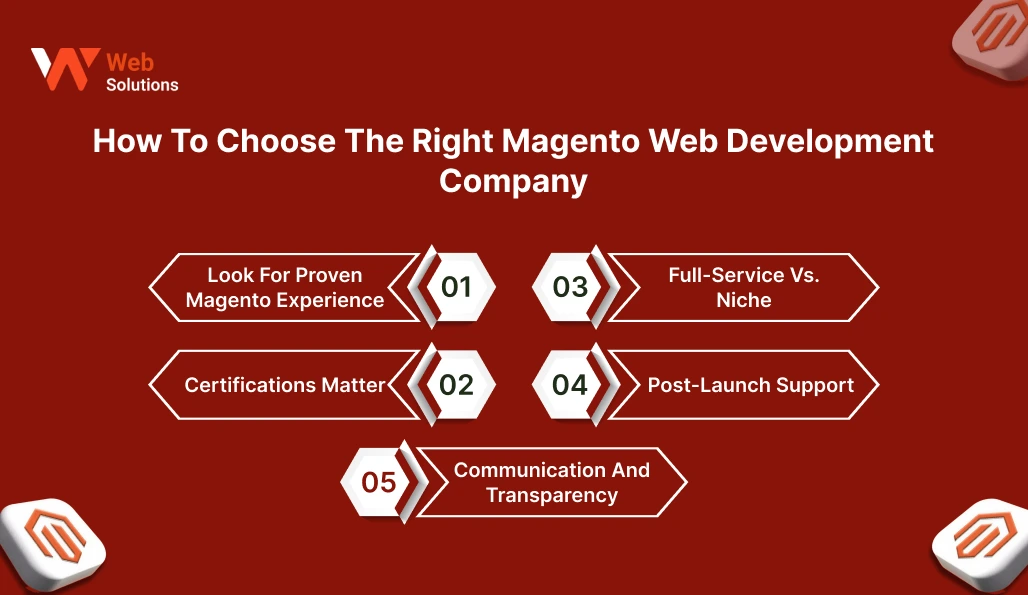
Choosing a team is not only about a nice portfolio. It is about who can keep your store stable after launch. Magento is powerful, but it is also easy to mess up with rushed custom work or too many extensions. You can avoid that mess and create a store that is quick, safe, and simple to update with the aid of the best Magento web development company.
Use these criteria to narrow down your shortlist of candidates for Magento web development services. They save you from costly rework later.
1. Look For Proven Magento Experience
Request Magento projects that resemble your store rather than just any e-commerce website. A small catalog differs greatly from a brand with 5,000 SKUs and layered navigation. Also, check if they have handled real pain areas like multi-store, migrations, and checkout customisation. In Magento web development, experience shows in how they talk about risks, not only features.
2. Certifications Matter
Although they lessen uncertainty, certifications do not ensure quality. Magento standards, upgrade routes, and best practices are typically known to certified developers. It also demonstrates how much time the team devotes to thoroughly understanding the platform. Find out how a company handles upgrades and complex work if they have no certified personnel.
3. Full-Service Vs. Niche
Some teams only build themes. Some only do backend and integrations. Some do everything end-to-end. Full-service can be easier because one team owns design, development, QA, hosting setup, and launch. Niche teams can be great if you already have parts covered. The key is to match the team to your needs, so your Magento web development solutions do not get split across too many vendors.
4. Post-Launch Support
Launch is the beginning, not the end. You will require bug fixes, module updates, security patches, and minor enhancements based on actual customer behavior. Inquire about post-launch support. Do they provide emergency repairs, monitoring, and monthly maintenance? A strong team will show a clear support plan, not vague promises.
5. Communication And Transparency
Magento work has many moving parts, so silence is risky. Pick a team that sends out weekly updates, clear deadlines, and links to staging for review. They should tell you what is being built, what is in the way, and what you need to do. Transparent teams also talk about trade-offs, like why an extension is risky or why a custom build will take longer. That honesty is what keeps Magento web development services on track.
Also, read: PHP Web Development in 2026: Trends, Tools, and Best Practices
Final Thoughts
Magento works best for brands that want room to grow. More products, more traffic, more rules, more integrations. It can handle that load, but only when the store is built with care. A rushed theme, weak hosting, or too many random extensions can turn a good platform into a slow checkout and daily fixes. That is why the build quality matters as much as the platform choice.
If you want to run an online store for a long time, don’t just think about launch day. Plan for upgrades, security fixes, speed tests, and real tests on older phones and networks that are slower. Also, keep scope tight in phase one. Get the core journeys right first, like search, product pages, cart, and payment success and failure flows. Then add new features based on what real customers do, not what you think they will do.
Web Solutions LLC offers Magento web development services that are designed for stable performance and scalability. If you want help from a team that plans, builds, and maintains Magento stores with a clean process, they can help. You get clear communication, practical delivery steps, and post-launch support that keeps the store steady when orders pick up.
FAQs
1. What Does A Magento Developer Actually Do?
A Magento developer creates and takes care of the online store components that both customers and employees interact with regularly. He or she, therefore, builds or updates themes, product pages, checkout, payment setup, shipping rules, and admin roles, etc. Besides, developers are also involved in app or extension installation, creation of custom modules, API integrations, and performance optimization. A competent crew considers Magento web development as a whole system, rather than a few pages. Thus, the majority of brands depend on Magento web development services to get stable launches and clean upgrades.
2. Why Hire Certified Magento Developers?
It is mainly the specialists who are most knowledgeable about the Magento standards, upgrade paths, and best practices. This, in turn, means fewer risky shortcuts in custom code and less likelihood of breaking your site when updating the new version. It is also very important to check security patches and extensions, since online stores are always being attacked. A good Magento web development company will have a mix of certified developers and good QA and DevOps. This makes sure that the store runs smoothly even after it goes live.
3. Is Magento Better Than Shopify Or WooCommerce?
The store’s needs will decide this. Shopify is usually easier for quick launches and simple catalogs. If you already use WordPress for your small store, WooCommerce is a good option. Magento is usually the better choice if you want more control and complicated pricing rules.
4. How Much Does Magento Development Cost?
Most small to medium-sized Magento stores spend between $30,000 and $150,000 USD. The exact amount depends on how many features they want, how much they want to change their theme, and how well they want to connect with other stores. A simple single site with basic features will cost less. Adding a multistore setup, store migration, custom checkout, along with ERP or OMS integrations is more pricey. After a project is finished, maintenance usually means paying a monthly fee for updates, fixes, and monitoring. If you want to better plan your spending, ask your Magento web development company for a plan that breaks down the work into phases. This way, you can launch core flows first and add extras later.
5. Can Magento Handle SEO Well?
As long as it is set up correctly, Magento is a very flexible platform for SEO. It has a lot of great features, like clean URLs, control over metadata, sitemaps, canonical tags, and well-organized category pages. All of these things make the basics of SEO easier. However, the real SEO benefits go to whoever masters the technical setup, speed, and clean indexing more than just the tags. Expert Magento web development services can do a lot to help Google get used to your site with Core Web Vitals, mobile performance, and even eliminate the chances of duplicate content coming from filters and layered navigation, so the rankings don’t drop just because the catalog gets bigger.