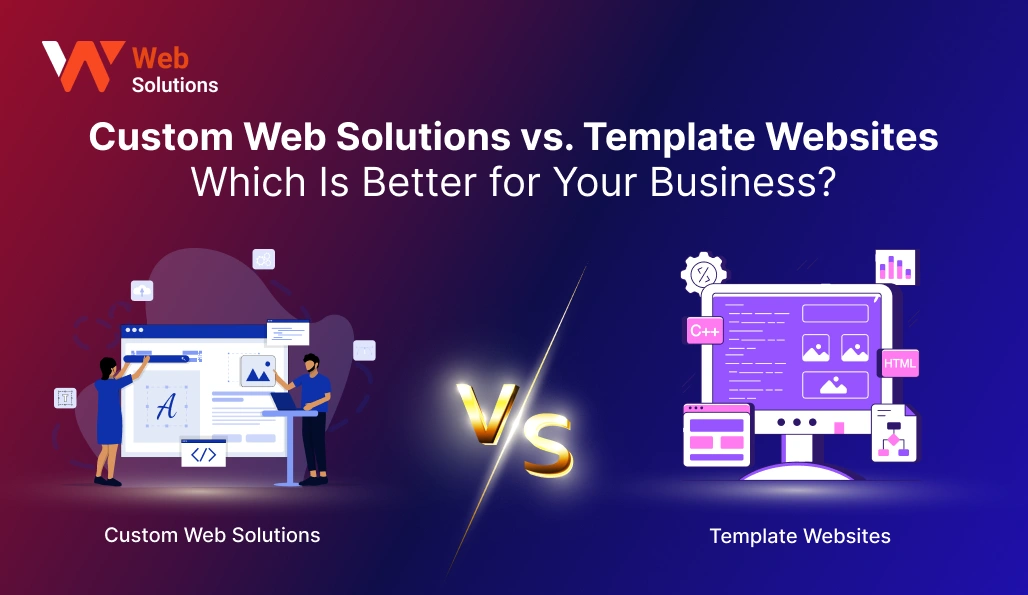
Custom Web Solutions vs. Template Websites: Which Is Better for Your Business?
The role of a company’s website used to be only a digital presentation, but it is no longer the case. The site has evolved into a vital business by attracting people, raising the company’s profile, simplifying the company’s operations and generating digital sales opportunities. In a market like the present one, where customers demand easy and personalized interactions, the website quality can have a significant effect on trust, engagement, and conversion rates.
Moreover, not all sites are equipped with the same characteristics. The decision as to whether to put money into custom web solutions or use template-based websites is a tactical one that determines how your online presence will function both now and later. Typically, firms that consider these features to be the main factors of their success, i.e. unique features, branding, and the possibility of future expansion, tend to opt for a custom-made solution development, while those who are basically seeking a speedy and inexpensive way of doing things may pick templates. Each way has its pros and cons, but it ultimately comes down to your goals, business needs, and development tactics.
This blog by comparing cost, development control, performance, security, and scalability factors, will clarify which approach aligns best with your company. Whether you are in need of full-service web development or are having a conversation with a professional web solutions provider, knowledge of these differences will ensure that your digital investment brings you measurable value and lasting success.
TL;DR
- Custom websites offer full flexibility and long-term scalable digital growth.
- Templates provide quick, affordable launches but limited customization options.
- Custom solutions support strong branding and unique business identity.
- Template websites restrict performance, scalability, and future functionality expansion.
- Choose based on budget, timeline, and long-term digital goals.
Key Points
- Custom web solutions provide complete design freedom, strong branding, and better long-term scalability.
- Template websites are cheaper and faster to launch but offer limited personalization and growth potential.
- Custom platforms deliver superior performance, security, and SEO optimization compared to template themes.
- Templates are ideal for startups needing a quick digital presence with simple functionality.
- Custom web development offers higher long-term ROI, while templates may require redesigning later.
- The right choice depends on your business goals, budget, technical needs, and growth expectations.
- Partnering with a professional web solutions provider ensures your website supports future expansion and evolving customer demands.
What Are Custom Web Solutions and Template Websites?
Custom Web Solutions
Custom web solutions involve designing and developing a website from scratch according to your business’s unique demands. These solutions are typically offered by a web solutions company or through specialized website development solutions. Everything, from layout, functionality, and UX design to backend architecture, is tailored for your organization.
Template Websites
Websites that use templates come with standard forms or themes that are ready to use but can be altered according to user content. They are typically the first choice for start-ups and small companies, as they give a fast and easy way to get a website done without much investment or technical development skills being required.
Key Differences: Custom Web Solutions vs Template Websites
It mostly hinges on company objectives whether one picks custom web solutions or template sites. In contrast to templates, a custom solution still carries more benefits, e.g., in terms of adaptability, expansion, brand identity, speed, and a higher return on investment over time, while templates are fast to roll out and cheaper but restrict personalization, security, and the possibility of growth.
| Factor | Custom Web Solutions | Template Websites |
| Design Flexibility | Fully customizable based on brand identity | Limited to pre-set layouts |
| Development Time | Longer due to custom coding and testing | Quick deployment, days to weeks |
| Initial Cost | Higher investment | Low to moderate cost |
| Scalability | Highly scalable for future integrations | Limited scalability, may require migration later |
| Performance & Speed | Optimized code ensures superior performance | Can be slower due to bloat in theme files |
| SEO Optimization | Easier to implement custom SEO architecture | Depends on template quality and plugin compatibility |
| Maintenance | Requires technical expertise or professional support | Easier to maintain, fewer technical dependencies |
| Branding | Unique look aligned with brand strategy | Common designs that many businesses may share |
| Security | High-level custom security options | Depends on theme provider and plugin security |
| Long-term ROI | Higher ROI due to flexibility and scalability | Lower ROI if redesign becomes necessary |
Benefits of Custom Web Solutions
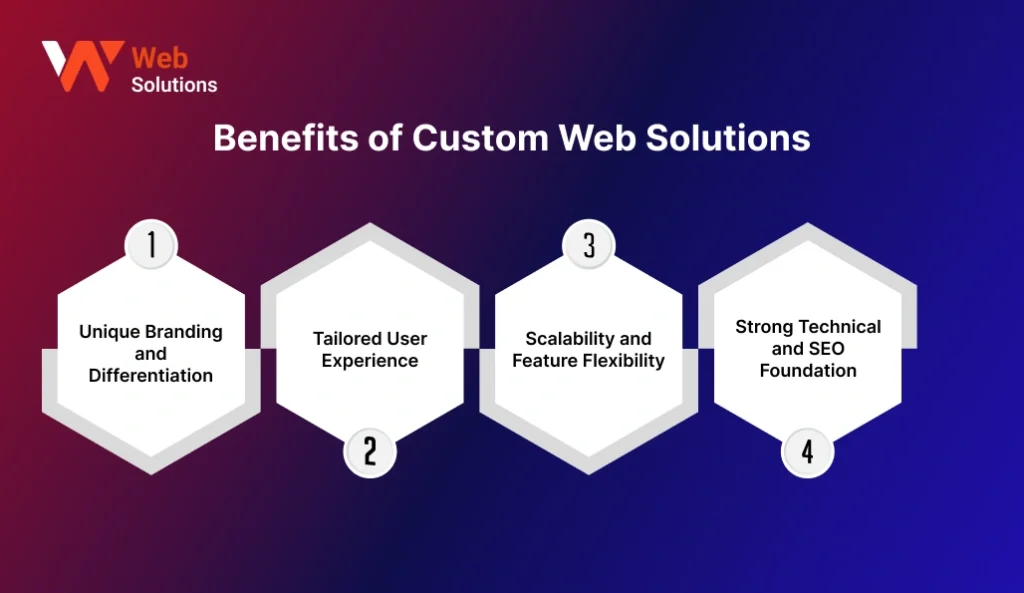
Businesses can create a website that is a perfect reflection of their brand, meets the expectations of their audience, and is in line with their future goals through custom web solutions. With a custom website, they have total freedom over the look, the functionalities, and even the speed of the site, thus guaranteeing a digital platform that is scalable, safe, and fast as well as personalized for stability in the long run.
1. Unique Branding and Differentiation
Custom websites are built from the ground up to visually communicate the brand, its character, and even its style. Such uniqueness allows businesses to differentiate themselves from those who are just using common templates. A tailored platform not only facilitates getting known, but also trust and brand loyalty, which in turn makes the brand more memorable and influential at the different digital points of customer interaction.
2. Tailored User Experience
By using custom development, every page, feature, and function can be made to directly mirror user behavior and business goals. The navigation, interactions, and information flow are deliberate processes aimed at raising engagement levels, easing the user experience, and guiding customers to the actions that have the greatest value for the business, thus leading to an increase in usability, satisfaction, and conversion rates.
3. Scalability and Feature Flexibility
When business requirements change, tailored solutions allow seamless integration of additional features, systems, and technologies without the need to significantly change your website. In case you decide to add any one of the following: booking modules, CRM systems, payment gateways, or custom dashboards, the platform will keep being your business partner and will not impose on you any limitations or structural constraints.
4. Strong Technical and SEO Foundation
Custom websites are the main reason for less than excellent page loading times, increased security and reliability of the site because they are coded with clean, optimized code and have minimal dependency on external plugins. Also, they empower advanced SEO tactics resulting in higher search visibility, well-structured content, and the ability to stay digitally competitive for a long time, something that templates are often not able to deliver effectively.
5. Limitations of Custom Web Solutions
- Higher initial investment
- Longer development cycle
- Requires ongoing support and maintenance
Benefits of Template Websites
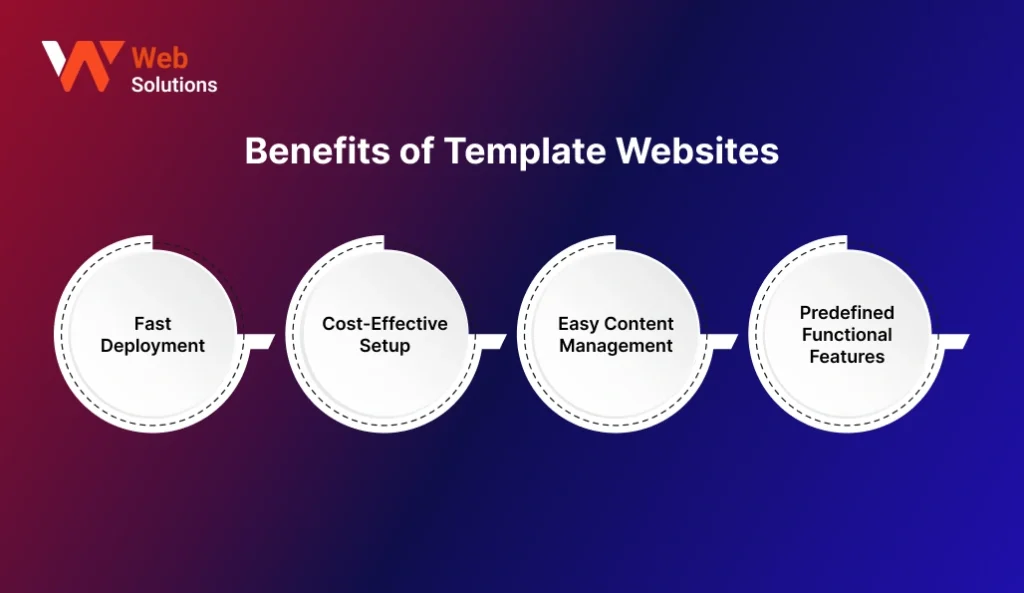
Template websites provide a quick and affordable way for businesses to establish an online presence without extensive development work. With ready-made layouts, built-in features, and simplified customization, they offer a practical solution for startups, small businesses, and projects with limited budgets or immediate launch needs.
Also Read: Startup web solutions for a powerful platform
1. Fast Deployment
Template websites can be deployed rapidly because most structural elements are already built. Businesses simply add branding, content, and basic settings, enabling them to go live quickly. This makes templates ideal for time-sensitive campaigns, product launches, prototypes, and minimum viable products requiring immediate digital visibility.
2. Cost-Effective Setup
Templates lower the upfront investment significantly, as they offer ready-made designs and necessary features for a very small amount of money. Companies are able to steer clear of costly custom development and use fewer technical resources; thus, templates become an inexpensive option for businesses that decide to save money and at the same time make a professional appearance on the web.
3. Easy Content Management
Nearly all template-driven platforms offer drag-and-drop builders along with simple-to-use dashboards that enable non-technical users to change pages, update information, and handle content with great ease. Such a move cuts off the dependence on developers for small changes and thus makes the process of website upkeep not only easier and quicker but also more reachable by the internal teams.
4. Predefined Functional Features
Template sites generally come with a set of tools that can be used right away like forms, galleries, payment modules, and SEO plugins. These plug-and-play components lessen the developer’s work, and thus, companies can have their fully operational websites up and running in no time, which is sufficient for their basic operational needs without having to make a custom code or complicated technical configurations.
5. Limitations of Template Websites
- Limited customization and branding
- Difficult to scale once needs grow
- Performance and security depend on third-party updates
- Similar designs used by multiple businesses reduce uniqueness
When Should You Choose Which?
The decision between custom web solutions and template websites depends on your business goals, technical needs, and growth strategy. Understanding whether you prioritize brand uniqueness, scalability, and performance, or value affordability and rapid deployment, helps determine the most suitable option for your digital presence.
Choose Custom Web Solutions if:
- You want a strong brand identity that differentiates your business from competitors
- You expect long-term growth and need a platform that supports scalable, flexible functionality
- User experience, performance optimization, and business workflows are top priorities that require tailored execution
Choose Template Websites if:
- You need a basic digital presence quickly without extensive planning or development cycles
- Your functionality requirements are limited to simple pages, forms, or content-based interactions
- Budget constraints prevent you from investing in custom development at the current stage of your business growth
Conclusion
Different business requirements are served by both methods. Custom web solutions result in a higher value, scalability, and performance, which makes them suitable for brands having long-term digital expansion plans. Template websites are the easiest and the cheapest way to establish an online presence, but they might become limiting when your business grows.
With a clear understanding of your goals, budget, and future plans, you will be able to make a wise choice. The partnership with a reputable web solutions firm will make sure your choice coincides with business growth, marketing strategies, and changing customer demands.
FAQ
1. Custom web solutions are what exactly?
Custom web solutions are one-of-a-kind business websites that have been designed with special characteristics, layout, and brand elements. They are more flexible, scalable, and faster than templates.
2. Are template websites a good choice for a startup?
Template websites are definitely good for start-ups that want to be online rapidly and not spend much. However, as the business grows and requires more advanced features or consistent branding, it might be the case that the website has to be changed.
3. Which alternative works out better long-term?
Custom web solutions are the ones that offer the highest long-term value due to the possibilities of scaling, performance, and customization. The templates cost less at the beginning, but at the end they will still have to be redone; thus, the total cost will be increased.
4. Do custom websites have a positive effect on search engine ranking?
The answer is yes; custom websites allow developers to have the most SEO-friendly code, optimized structure, and performance improvements from the very start so that the chances of getting a higher ranking on search engines will be increased.
5. Is it possible to switch from a template website to a custom solution later?
It happens quite often that a company starts off with templates and moves to custom web solutions when it has validated its market and is looking for advanced digital features. The advantages of such a staged approach are lower initial costs and a greater chance of growth.